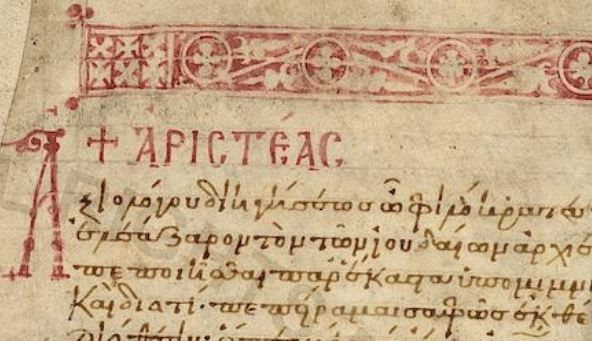
Letter of Aristeas
The Letter of Aristeas is a Hellenistic Jewish text, probably from the 2nd–3rd century BCE, that narrates the legendary origins of the Septuagint, the Greek translation of the Torah. Imagine Judaism hiring a Hellenistic spin doctor: that’s Aristeas (a literary pseudonym, ostensibly a courtier in Ptolemy’s court, but more likely an Alexandrian Jew who wanted to make Judaism acceptable in Greek social and political circles). He stages the Septuagint’s birth as a miracle of translation, seventy-two scholars producing identical texts. Beneath the miracle, the letter is a sales pitch – Judaism as rational, ethical, and library-worthy. It’s less about history than about branding: Torah as timeless wisdom, fit for the shelves of Alexandria and the minds of philosophers. The letter was consigned to the Jewish apocrypha because it was judged pseudepigraphal (falsely attributed to an important figure), legendary rather than historical, and primarily apologetic in nature, not to transmit divine revelation.
The letter consists of 322 paragraphs, so I’m not going to do them one at a time, but will give a shot at breaking this up into sensible concepts that are expressed.
- Paragraphs 1-8. Aristeas kicks off with a classic PR move: “Philocrates, trust me, I was there.” Philocrates is less brother than rhetorical sock puppet, a Greek-sounding confidant invented to make the tale feel cozy. The author flexes his supposed insider status at Ptolemy’s court, positioning himself as the guy with the backstage pass to the king’s grand project of stocking Alexandria’s library with the world’s wisdom, including the Jewish Law. The intro is pure stagecraft: credibility asserted, audience imagined, Judaism’s laws dressed up for their debut on the Greece’s cultural catwalk.
- Paragraphs 9-11. Demetrius is the king’s librarian, caught between shelves and politics. He knows the library is a Babel of alphabets, but Hebrew feels especially opaque. His worry isn’t xenophobia, it’s quality control: how to know which scrolls are worth cataloguing if he can’t read them? The king’s letter to the high priest is the workaround: outsource discernment to the guardians of the tradition. Moses’ Torah enters Alexandria not by Demetrius’ linguistic scholarship, but by priestly authority. The librarian’s role is less curator than facilitator, ensuring the gold standard of Jewish texts is transmitted intact, even if the alphabet looks strange to Greek eyes. Today, we can be amused by the thought of the Greek alphabet being the alphabetic standard.
- Paragraphs 12-20. Aristeas shifts from librarian to lobbyist, petitioning for Jewish slaves like a courtier with a conscience. He plays the bureaucracy like a prelude, then hits the king with the big ask: not just freedom, but back pay. Miraculously, Ptolemy agrees; emancipation plus remuneration, a royal two-for-one. Mystical spin? The Torah isn’t just fit for the library; its people are fit for liberty. Worth noting… the Exodus said “we’re outta here,” but Aristeas rewrites the script: apparently, enough Jews wandered back or stuck around to get re-enslaved, first by Egyptians, then inherited by Greeks. Plot hole? Absolutely. But it’s a convenient one, because it lets Ptolemy cosplay Moses, freeing slaves and cutting checks.
- Paragraphs 21-27. Ptolemy issues his decree: Jewish slaves are freed, their bondage declared unjust. Cue the royal benevolence soundtrack. But when the treasury opens, the coins jingle not for the liberated, but for their ex‑masters; compensation for “losses.” It’s emancipation with a side of economic appeasement: freedom for the captives, hush money for the owners, and PR glory for the king. Liberation, yes, but reparations flow uphill.
- Paragraphs 28-40. Demetrius, the librarian with standards, memos Ptolemy: “Your Jewish texts section is a mess, with shoddy translations everywhere.” Ptolemy, keen to polish his image as enlightened monarch, fires off a decree to High Priest Eliazar of Jerusalem: “Send six scholars from each tribe to fix this”. To underline his magnanimity, he reminds Eliazar that he freed over 100,000 Jewish slaves, and then drops a sweetener of 100 talents of silver, nearly four tons, like a kingly flex that says, “I’m serious about this project.” The whole episode reads less like reverence for scripture than bureaucratic theater: a memo, a decree, a bribe, and a PR flourish, all to ensure the library shelves don’t look shabby.