Book of Judith
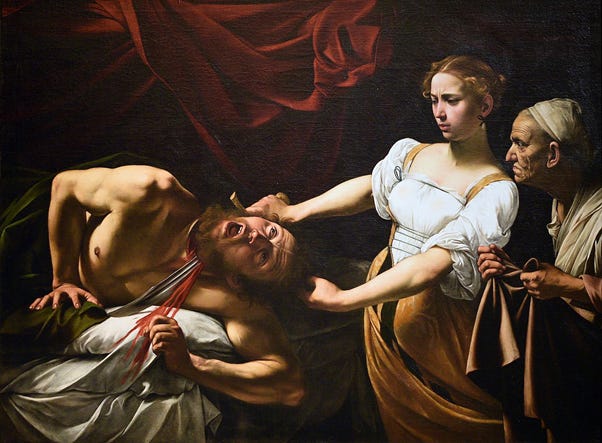
The Book of Judith is a dramatic tale set during an imagined Assyrian siege of the Jewish town of Bethulia. The Assyrian general Holofernes, under orders from King Nebuchadnezzar, threatens to destroy the town. Judith, a devout and beautiful widow, devises a bold plan: she infiltrates the enemy camp, charms Holofernes, and ultimately beheads him while he sleeps. Her act of bravery inspires the Israelites to launch a counterattack, routing the Assyrian forces and securing their freedom. The narrative blends themes of faith, courage, and divine intervention, with Judith portrayed as a symbol of pious resistance and female heroism. Despite its vivid storytelling, the Book of Judith is considered apocryphal because it was excluded from the Hebrew Bible and Protestant canon. It is included in the Septuagint (the ancient Greek translation of Hebrew scriptures) and accepted in the Roman Catholic and Eastern Orthodox traditions. Scholars have long questioned its historical accuracy—Nebuchadnezzar is misidentified as king of Assyria rather than Babylon, and the town of Bethulia is unknown outside the text. These anachronisms, along with its literary style and theological themes, suggest it was written as a fictionalized moral tale rather than a historical account, likely composed in the second or early first century BCE.
- It’s the days of King Nebuchadnezzar, who rules over the kingdoms that these days are basically Iraq and Syria from his capital in Nineveh (modern day Mosul, more or less). He’s in battle with King Arpachshad of Medea out of Achmeta (modern day Hamedan, Iran). Nebuchadnezzar calls for alliance from the lands to the south and west (modern day Saudi Arabia, Jordan, Lebanon, Israel, Egypt, etc.) but most refuse to come to his aid. He forges ahead, defeats Arpachshad, destroys the city of Achmeta, wipes out most of the Persian population, and then returns to his castle where he celebrates and feasts for four months. Part of why this book is considered fictional is that Nebuchadnezzar was not the king of Assyria, but of Babylon, much further to the south, and was never based out of Nineveh or that kingdom.
- Nebuchadnezzar is still pissed off about the southern and western nations not coming to help him in his battle against Medea. So he calls all his advisors together and they all agree, it’s time to wipe those places off the face of the earth. He orders up 120,000 infantry and 12,000 cavalry, and leads them into a series of slaughters against one after another of those surrounding nations, completely destroying them as he marches through the region.
- As Nebuchadnezzar advances on his campaign across the Levant, he gathers power, and the kingdoms he hasn’t yet reached are fearful. They send envoys to ask for peace, offering their loyalty and obedience to him. He accepts, and creates a garrison of troops in each kingdom with enough men to maintain control by fear. Then he relaxes and ponders for a month.
- Now the Jews down in Israel are getting worried as Nebuchadnezzar’s army, under the command of Chief Captain Holofernes, is drawing closer. Their rulers and high priests send out the armies to make sure the entire frontier is fortified, and word is sent to every town in the region to arm themselves and prepare for the onslaught. Further, the entire nation fasts, and offers sacrifices, and prays to God for his favor and intercession. This is a very long setup for what I assume will be the main story in the book.
- Holofernes, the chief captain, is not pleased that the Israelites have fortified their defenses rather than just surrender. He calls his captains together to demand why. Achior, of Ammon, tells him the history of the Jews from the time they discovered the true God, to the present, and how he has protected them from one after another enemy. He suggests that perhaps bypassing Israel would be the better move, as their God is likely to step in and protect them.
- Holofernes is not happy with Achior’s story about why the Jews are fortifying their defenses. His other advisors suggest killing Achior for treason – kill the messenger and all that. Holofernes orders him bound and tossed at the foot of the hills surrounding the Israelite defenses to be killed by them. Instead, they rescue him, question him, and he, having been maltreated by his own people, tells them all. They thank him and hold a feast in his honor.
- As Holofernes prepares to attack Israel, his advisors point out that attacking the Israelites who are in mountaintop fortifications, is likely to cause huge losses among his troops, even though they will prevail by shear numbers. They suggest a siege and cutting off the water supply. He agrees. After 34 days, the Israelites are without any water, and approach their leader, Uzziah, and ask him to surrender the region to Holofernes, as it is clear God has abandoned them. He asks them to wait five more days for God’s intercession, and to pray with him for it, and if it doesn’t happen, he’ll do as they ask. They agree.
- Judith makes her appearance. A widow now for three years and four months, since heatstroke killed her husband, she has spent that time in mourning, and is widely respected as a highly spiritual woman. She calls Uzziah and the other leaders to her home and castigates them for, in essence, issuing a challenge against God to show up in the next five days “or else”. She admonishes them to keep the faith, and then announces that she and a servant are taking the matter in hand, and will be slipping out of town that night, and not to ask questions – she’ll explain everything when she returns within the five day window.
- Judith throws on her sackcloth and covers her face in ashes (why, oh why, is this considered a part of praying to God in so many circumstances?) and launches into a monologue to God. She reminds him of the past, when her forefathers and foremothers were given the strength to prevail against invaders. She regales him with what she expects the Assyrians plan to do to the Jewish people. And, she asks him to step in and help her bring down the leader of the Assyrian assault.
- Judith, finished with her prayers, goes home, removes the sackcloth and her widow’s garb and dresses to the nines, ready for a night out on the town, as she used to do when her husband was alive. Along with her maid, and gifts of wine, bread, and figs, she heads to the city gates where Uzziah and the other elders await. They’re amazed at her transformation, and at her request, open the city gates. She immediately heads to the Assyrian camp where she is captured, and tells her captors that she has “escaped” and has information for Holofernes that will help him take over Israel. They take her to him, where she bows down before him.
- Holofernes tells Judith that she is safe with him. But, he wants to understand – here he is, leader of an army that is simply there to takeover Israel, a land that his king, Nebuchadnezzar, wants to claim, and here the Jews are defending what they claim is their land historically, against his army, and can’t they see that it’s their fault for having defended against him that this battle is even happening? Hmm… why does this sound so… familiar? Judith tells him there is a secret plan to use up stores of food and drink that are normally prohibited to Jews, but in order to hold out longer, and if he waits for her to get a sign from God, she’ll lead him via a secret path, to victory.
- Holofernes invites Judith to dine with him. She declines, proclaiming that even in her self-chosen exile, she will continue to eat kosher food, which, she says, she has brought sufficient with her to sustain her until this venture is complete. Holofernes allows this to go on for three days, and each day, she dines solo, and then prays by the river. On the third day, he sends his servant Bagoas to insist that she join him for dinner. She agrees, dresses up provocatively, and joins Holofernes for dinner. They eat and drink heartily, in fact, he is so enamored of her that he drinks “more than he has ever drunk in his life”.
- As everyone toddles off to bed to sleep off the effects of the wine, Judith tells Bagoas that she and her maid are off to say their prayers beforehand. He bids her goodnight and leaves her alone with Holofernes, who has, by now, passed out on his bed. She grabs up his sword and grabbing him by the hair, hacks off his head with two strokes of the broadsword (quite impressive, one handed…). Then she wraps the head in the canopy from his bed, calls her maid, puts it in their food bag, and they head out like they are going to say prayers. Instead, they sneak out, return to the mountains, are greeted with first surprise, then elation, when she displays the severed head.
- Judith tells the assembled folk to stick Holofernes head on a pike and put it where the Assyrians below can see it, and then form up their ranks as if they’re going to attack. She also asks that Achior, remember him, the Assyrian guy who was expelled for suggesting the the Israelites had God on their side? She has him brought to her so he can see what she’s done, at which he decides to convert to Judaism and has himself circumcised on the spot. Then they stick the head on the pike, the Assyrians see it, Bagoas goes to Holofernes tent, finds his headless body, goes to Judith’s tent, finds it empty, and the Assyrians go in for the usual rending of clothing and weeping and wailing.
- The Assyrians are in a panic with the loss of their chief, Holofernes, and the scatter, running for their lives. The Israelites chase them down and slaughter them, and send messengers to surrounding kingdoms that Holofernes had already conquered, to do the same. Much slaughtering, much looting, much “despoiling”. All of Holofernes belongings are given to Judith, who then leads a parade and dance of celebration at the destruction of the Assyrian army.
- Apparently skilled in adlibbing songs, Judith sings out the entire adventure detailed in all the previous chapters. Over and over, for a month, as the Israelites celebrate. Then she retires to her home, where she lives out her life as an honored person, to the age of 105. On her death, the entire nation mourns her for a week.
On to “Additions to” Book of Esther