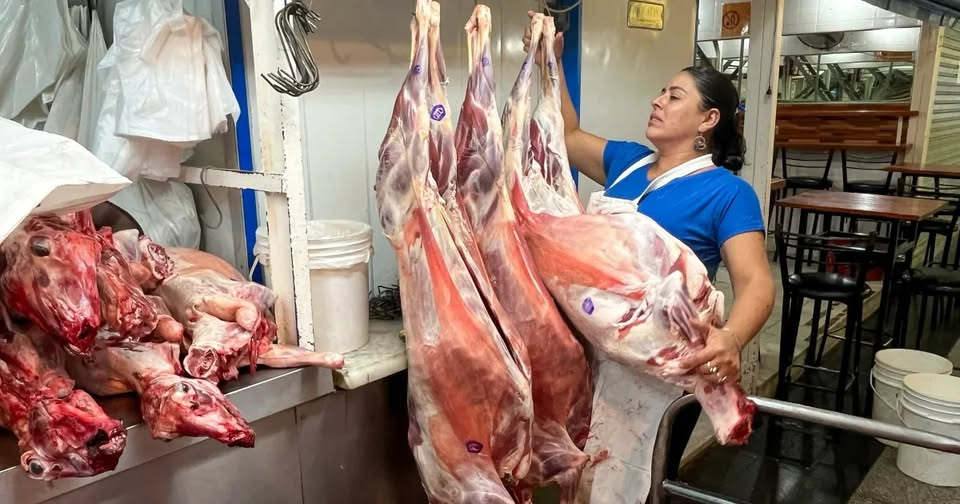
 Chullin – “Mundane” – Any Way You Slice It
- Chullin vs. Zevachim is the rabbinic split‑screen with a new knife and a new backdrop. Zevachim is temple slaughter as sacrificial theater where animals are consecrated, blood flung altar‑side, meat consumed in sacred precincts. Chullin takes that choreography and drags it into daily life, stripping away incense and priestly pomp to focus on the mechanics of everyday kosher butchering. Where Zevachim dramatizes sacrifice as divine spectacle, Chullin insists that Tuesday’s chicken dinner is still covenantal, provided the blade is sharp and the cuts precise. One sanctifies the act of slaughter through ritual context, the other through technical perfection. It’s a continuum where holiness doesn’t vanish when the altar is gone, it migrates to the kitchen counter, carving knife in hand.
- 5/2/26, Chapter 1, Page 2 – Chullin kicks off by handing out butcher’s licenses like candy, everyone’s in, except the rabbis’ favorite punching‑bag trio: minors, imbeciles, and deaf‑mutes, written off as too clumsy or untrainable to trust with a blade. Women get grudging approval, a kind of “fine, but don’t mess it up,” while the ritually impure are allowed in with the Bronze Age equivalent of latex gloves: a long knife to keep their grubby hands off the carcass. The whole thing reads like a mash‑up of inclusivity and suspicion; yes, let’s democratize slaughter, but also let’s remind you who we think is competent, and who just isn’t.
- 5/3/26, Page 3 – The Samaritans were the sectarian near‑neighbors of Judaism – descendants of the northern tribes who clung to their own Torah centered on Mount Gerizim and rejected rabbinic authority. They observed many biblical laws, but selectively, which made them suspect in rabbinic eyes. In kosher butchery, that suspicion sharpened: shechita requires exact technique and rabbinic fine‑print, and while Samaritans might perform the cut correctly, they could mishandle knife inspection, blood draining, or intent. Unlike gentiles, who were outright excluded from kosher slaughter, Samaritans occupied a gray zone; close enough to be dangerous, because their meat looked kosher but carried the risk of sectarian shortcuts.
- 5/4/26, Page 4 – We’re still on Samaritans, and a “bite‑test” that reads like rabbinic quality control designed by Kafka. The Samaritans are kosher eaters but allegedly their prep work is questionable, so the sages invent a ritual where you hand them a slice of their own meat or bread and watch them munch. Voilà, kosher certified! Except it proves nothing beyond their willingness to swallow their own mistakes. The whole move exposes the rabbis’ uneasy dance between communal trust and technical suspicion: Samaritans are kosher in principle, but suspect in practice, so the rabbis settle for a symbolic nibble that lets them sleep at night while pretending they’ve enforced standards.
- 5/5/26, Page 5 – Today’s page reads like the rabbis opened a casting call for “Kosher Kitchen Nightmares” and staffed it entirely with transgressors: idolaters, Sabbath‑skippers, wine‑tamperers, and the vaguely shady “suspected” crowd. The satire practically writes itself. Imagine a butcher’s guild where the HR department has to decide which sinners are still allowed to wield the knives. Some get blacklisted outright (too much moral grease on their apron), while others are grudgingly tolerated because, hey, at least they can hit the jugular cleanly. The discussion becomes a bureaucratic tasting menu of sin: “Break Shabbat? Supervision required. Pour libations? Out. Gossip too much? Fine, just wash your hands first.” It’s less about the meat than about drawing the line between insiders and outsiders, with the rabbis playing sous chef, deciding who gets to work the line and who’s relegated to prep work.
- 5/6/26, Page 6 – Today is basically the rabbinic etiquette manual for edible gift‑exchange, and it’s deliciously neurotic. The sages are worried not just about whether the food is kosher, but about the social vectors of who’s handing it to you. Enter the comic duo: your neighbor’s wife and your mother‑in‑law. Both are singled out as suspicious sources of food gifts, which is a rabbinic way of saying “beware the casserole diplomacy of women with ulterior motives.” The humor practically writes itself. Modern jokes about mother‑in‑law cooking being suspect have a Talmudic pedigree: the rabbis literally canonized the idea that her pot roast might be dangerous. And the neighbor’s wife? She’s the archetype of suburban casserole politics, centuries before suburbs existed.
- 5/7/26, Page 7 – Our page today reads like a sitcom pilot. Rabbi Meir casually plucks and nibbles a leaf from some untithed vegetable bundle that no one bothers to tell us what vegetable, as if the produce deserves witness protection, and the sages spin pages of halakhic fallout over his transgression. Enter a donkey, reasonably assumed to be non-Jewish, uncircumcised, and not having attended a yeshiva, who refuses untithed barley with the kind of moral clarity most humans can’t muster. An entire page devoted to rabbis agonizing over leafy greens and a beast of burden playing kosher cop.
- 5/8/26, Page 8 – Today is the rabbinic physics lab where metallurgy meets metaphysics: the sages line up knife, skewer, and glowing iron like gladiators in an arena, then argue over which lands the first blow. Is it the blade’s edge slicing, the skewer’s point puncturing, or the “white‑hot heat” radiating before contact? Instead of conceding simultaneity, they insist on a hierarchy of causation, parsing damage into neat categories as if reality itself must obey rabbinic sequencing. The tractate turns into a kind of legalistic cook‑off: your meat isn’t ruined by knife, skewer, and flame together, but by whichever the rabbis crown as the primary culprit.
- 5/9/26, Page 9 – Oh my… it’s rabbinic food‑safety theater, with wolves, birds, snakes, and weasels crashing the butcher shop to test the limits of kosher logic: wolves abscond with entrails needed for certification, leaving sages to puzzle over whether missing evidence voids the verdict; birds peck melons to disguise a snake’s puncture, raising the double specter of venom and creeping‑thing impurity; and weasels parade carrion across bread loaves, contaminating the daily staple with slapstick menace. It’s less reportage than imaginative stress‑testing, a series of “what if” riffs that turn the kosher kitchen into a stage for forensic doubt, contamination anxiety, and the comic absurdity of trusting ritual purity in a world where animals refuse to stay in their lanes.
- 5/10/26, Page 10 – Today we have the Talmud’s cautionary tale about the dangers of running a subterranean minibar. The sages decree that three liquids – water, wine, and milk – must not be left uncovered overnight, especially under the bed. The rationale? Passing snakes might inject venom, or weasels might dribble saliva into your midnight refreshment. Later sages, armed with a bit more zoology, pointed out that snakes don’t squirt venom while sipping, and even if they did, swallowed venom isn’t poisonous. As for weasel spit, it’s more gross than lethal. So the whole prohibition ends up looking like a mix of folk biology and rabbinic over‑caution, eventually waved off in places where snakes and weasels weren’t nightly houseguests.
- 5/11/26, Page 11 – The discussion is basically the rabbinic version of a crime‑scene inventory gone culinary: severed spines, split heads, and slabs of anonymous beef lounging in the street, with the sages furrowing their brows not over hygiene but over the probability of did this hunk come from one of the kosher shops or the lone treyf butcher? The absurdity is that no one pauses to ask whether street‑meat should count as food at all, and the whole exercise reads like a Talmudic seminar in statistical theology rather than a guide to sensible dining. If you’ve misplaced half a cow and don’t know where the other half wandered off to, maybe the bigger issue isn’t kashrut but your inventory control.
- 5/12/26, Page 12 – The text tightens into a poultry farce: the rabbis wring their hands over whether you can trust a butcher’s bird if you didn’t personally watch the throat‑cutting, then spin scenarios of found chickens – kosher if discovered in a kosher home, treyf if lounging on a garbage heap, and a halakhic coin‑flip if the heap happens to be inside a kosher home. But the Animaniacs style show‑stopper is the butcher who flings a knife at a wall, only for it to perfectly slit the throat of a passing chicken in mid‑flight, and the rabbis, apparently tickled by the cosmic timing, declare it kosher.
- 5/13/26, Page 13 – Today’s page sketches a geography‑based theology of idolatry: gentiles in ancient Israel were treated as deliberate rebels, consciously rejecting Torah in its own homeland, while gentiles abroad were seen as merely following ancestral custom, quaintly provincial rather than actively defiant. Meanwhile, heretics, Jews who knowingly defect, were judged more corrosive than outsiders, since betrayal from within undermined the covenant itself. The same incense‑burning looks like rebellion in Jerusalem but harmless tradition in Athens, a reminder that rabbinic categories of sin hinge less on the act and more on “you should know better”.
- 5/14/26, Page 14 – Today’s argument reads like rabbinic theater of the absurd: the sages coolly declare that a slaughter on Shabbat or Yom Kippur is perfectly valid for the cow, mazel tov, the steak is kosher, but the butcher earns himself a death sentence for having cut it. It’s the ultimate “your work is acceptable, but you’re fired… permanently.” And just when you think the logic can’t get weirder, they dive into a travel debate, where placing food at two boundaries turns into a metaphysical squabble over whether you can pre‑declare both paths open in advance, or only one, after you’ve made the choice of which direction to travel. The traveler ends up in a questionable quantum state, a Schrödinger’s eruv that’s simultaneously valid and invalid until observed.
- 5/15/26, Page 15 – We keep the absurdist theater rolling: yesterday’s condemned butcher gave us kosher steaks with a death sentence on the side, and today the rabbis argue over whether those steaks can actually be eaten before sundown. One camp shrugs: if the meat is kosher, dig in, Sabbath or not; the other camp insists on a halakhic cooling‑off period: yes, it’s kosher, but don’t you dare chew until the stars are out. It’s a paradox of permissibility, kosher in essence, forbidden in timing, where the rabbis split hairs between the metaphysics of slaughter and the etiquette of consumption. In effect, the cow is fine, the butcher is dead, and the diners are left waiting for nightfall to see if dinner is legally on the table.
- 5/16/26, Page 16 – Today reads like OSHA meets theology: the rabbis insist that kosher slaughter requires a butcher gripping a free‑standing knife, not leaning on some wall‑mounted blade like a lazy handyman. Clamp it in a holder if you want, but you still have to push and pull with your own muscles. Cue the debate over whether this is modeled on Abraham’s knife at the Akedah, though critics rightly note that nearly sacrificing your son is not the same as prepping brisket. The sages dismiss divine cutlery sprouting from walls or earth as irrelevant; God may plant knives, but halakhah demands human agency. And then there’s the comic tangent: the requirement of a single, smooth stroke makes one wonder how a butcher would manage with a clamped blade – manhandling a cow across the table edge like some rabbinic strongman act? The logistics are absurd, more circus act than slaughterhouse, but the point remains: no divine hacks, no passive accidents; just you, your hand, and the cut.
- 5/17/26, Page 17 – Continuing on from yesterday’s blade positioning, today boils down to two intertwined rules: the motion and the blade. Slaughter must be performed with the prescribed smooth, continuous, and and intentional throat‑slitting stroke, while stabbing or jabbing is strictly out. At the same time, the rabbis allow a wide range of tools, from knives to shards of glass to reeds, but only if inspected to ensure they’re free of teeth or notches that would tear rather than slice. The page is essentially rabbinic choreography plus quality control: a graceful cut with a vetted edge, not a ragged hack or violent thrust.
- 5/18/26, Page 18 – The text is a study in rabbinic micromanagement of surfaces: first the altar, where for the first time we suddenly hear about a “limestone coating” that never appeared in Torah or earlier tractates, and the sages fuss over whether a chip in it counts as real damage; then the cow’s throat, where they argue over which tracheal ring is the kosher bullseye, confidently declaring the top ring uniquely circular even though bovine anatomy says all the rings are open horseshoes. Put together, it’s rabbis moonlighting as building inspectors and amateur anatomists, creating or ignoring details as they create law.
- 5/19/26, Page 19 – Today’s page reads like the rabbinic version of a blooper reel in a butcher’s shop: one sage insists that a slip of the knife still counts because hey, the trachea’s cut, while another frets that divine law isn’t meant to be slapstick; then they argue whether a cow with a pre‑existing throat hole is being “slaughtered” or just “finished off,” and whether two guys tag‑teaming the cut makes the meat kosher or just a group project gone wrong. The whole page is less a logical flow than a frantic attempt to legislate every possible accident, pause, and jagged slice; proof that when it comes to ritual slaughter, the rabbis were determined to turn every mishap into a case study rather than admit sometimes the butcher just botched it.
- 5/20/26, Page 20 – The text today is basically the rabbis’ poultry improv night, where every sage auditions a different way to dispatch a bird and the results veer from the grotesque to the absurd. One insists on a delicate pinch, another on a twist worthy of a carnival contortionist, while the more macabre suggest snapping or severing outright. Then the truly deranged imagery arrives: sages debating whether one might use a tooth or a fingernail as kosher implements, conjuring visions of rabbis gnawing chickens like medieval vampires or manicuring their way through a flock. And just when the audience is gagging, the rebels stroll in with a shrug:
“The Torah never specified how to slaughter birds, so anything goes.” - 5/21/26, Page 21 – Today, the rabbis legislate the geometry of death. The rabbis aren’t just nitpicking angles for the sake of geometry; they’re worried about outcome. A vertical, lengthwise cut often severs the pipes in a way that leaves the bird convulsing, twitching, or lingering rather than producing the clean, instantaneous death that a crosswise stroke delivers. Geometry isn’t just aesthetics, it’s ethics. The rabbis are saying: “A kosher cut must be both correct in angle and merciful in effect.”
- 5/22/26, Page 22 – The discussion reads like a rabbinic comedy sketch where the phrase “doves and young pigeons” becomes a springboard for logic‑gymnastics. Instead of taking it straight that all doves are fine and only young pigeons are fine, the sages vault into symmetry. If pigeons are only valid when young, then doves must be only valid when old. Thus, the rule morphs into a bird‑age caste system. The punchline? The pigeons that survive adolescence strut around like they’ve dodged the sacrificial chopping block (you’ve seen them, face it), while the doves grow increasingly anxious with each passing birthday, knowing their senior years are the rabbis’ preferred offering. It’s less divine ordinance than a Monty Python routine about poultry age discrimination.
- 5/23/26, Page 23 – The rabbis, still hungover from yesterday’s pigeon‑dove age wars, now warn us against offering birds that have been corrupted; meaning idol worship or bestiality. One imagines a pagan sect bowing to a youthful squab on a pedestal, or a scandalous brothel where old pigeons ply their trade. The absurdity is the point: the sages aren’t cataloguing real cults, they’re flexing their legalistic muscles, turning ” “corruption” into a catch‑all bogeyman. In the end, the sacrificial altar isn’t about keeping birds pure at all, it’s about rabbis flexing their paranoia, banning phantom pigeon cults and dove scandals so they can look busy policing sins that never existed.
- 5/24/26, Page 24 – The Temple wasn’t staffed by priests and Levites so much as curated like a fashion brand. Age limits kept out the gawky teens and the creaky elders, blemish bans weeded out anyone with scars, limps, or imperfect voices. It’s less theology than runway management: the altar as a catwalk, the Levite choir as a boy band. Think Abercrombie & Fitch, but instead of blond, waxed models in distressed jeans, the rabbis wanted prime‑aged, unblemished Israelites in linen tunics. The message was the same; perfection sells. A&F markets aspirational bodies to mall kids; the rabbis marketed flawless vessels to God. Both exclude the “unfit,” both curated an image of purity, and both left the rest of humanity standing outside the store.
- 5/25/26, Page 25 – The kitchen morphs into a rabbinic horror show where every vessel is a suspect: clay pots are the clingy villains, once tainted they never let go, their airspace a toxic cloud of impurity; metal pans are sleek conductors, especially flat ones, transmitting contamination like a live wire, though unfinished metal gets a pass for being too unready to matter; wood plays the rustic innocent, with flat boards immune to impurity but unfinished bowls soaking it up like spilled wine until they’re sealed and hardened; and then there are the mustard seeds, the super-spreaders of the pantry, one seed falling into an impure clay vessel instantly turning all mustard seeds in the vicinity into a spiritual quarantine zone. The rabbis aren’t describing kitchen hygiene so much as staging a cosmic drama where every ladle, pot, and seed is a character in the soap opera of purity law.
- 5/26/26, Page 26 – This page is one of those “rabbinic junk‑drawer” folios where the sages sweep up loose ends: grape juice versus wine (is it sanctified if it hasn’t bubbled yet?), shofar blasts, havdalah rituals. All of that is quirky but tolerable. Then the b‑side drops us into the abyss: a debate over the age at which a man who has purchased a minor girl from her family owes a fine for raping her. The options on the table: age one, age three plus a day, or puberty; are chilling. It’s not just the grotesque fact of the act itself, but the way the rabbis frame it as a technicality of compensation, as if the moral horror is secondary to the bookkeeping. The text forces us to confront the unsettling reality that ancient legal discourse could normalize exploitation by parsing it into thresholds and fines. It’s a reminder that halakhic casuistry, for all its brilliance elsewhere, sometimes veers into territory where the very act of debate feels complicit in erasing the victim’s humanity.
- 5/27/26, Chapter 2, Page 27 – The rabbis take the technical act of bird slaughter; the precise cut through windpipe and crop, and read it through Leviticus 1 as more than ritual mechanics, seeing in the silencing of the bird a metaphor for silencing sin. Speech, they argue, is the conduit through which transgression most often flows, via gossip, false vows, and blasphemy. The cut becomes symbolic of restraint, a reminder that sanctity requires vigilance over language. The bird’s voice, severed in sacrifice, is not punishment but parable: a mirror held up to humanity, urging discipline over the tongue, where speech may become a weapon for evil.
- 5/28/26, Page 28 – The sages rehearse a favorite paradox: ritual precision versus moral optics. Birds, though textually neglected, are dragged under the same knife choreography as cattle, because Deuteronomy’s “herds and flocks” must surely mean “copy‑paste the method.” Then comes the vein‑puncture squabble: one camp touts efficiency – let the heart pump out the blood before the cut, cleaner meat, faster drainage. The other camp clutches the “don’t be cruel” banner, insisting that prolonging the bird’s agony for the sake of neatness is barbaric. The result? A debate that reads like a butcher’s manual with a conscience problem: is kosher slaughter about ritual fidelity, or about mercy in motion? The rabbis, as usual, manage to argue both sides while sharpening the same blade.
- 5/29/26, Page 29 – Sacrificial birds are the Temple’s VIPs: doves and pigeons (I’m guessing not the same as NYC pigeons), humble enough to symbolize penitence, common enough that even the poor could afford them, and scripturally stamped as altar‑worthy. Non‑sacrificial birds such as chickens, geese, and turkeys are the kosher hoi polloi, perfectly fine for the dinner table but barred from the altar. The mechanics of slaughter don’t change – windpipe, esophagus, swift cut – but the venue and officiant do: priests in the Temple for the chosen few, kosher butcher in the marketplace for the rest. The contrast is less about biology than theology: God’s altar is a minimalist menu, while human kitchens are a buffet. In short, pigeons get incense and holiness; turkeys get gravy and stuffing.
- 5/30/26, Page 30 – The rabbis, apparently bored of teaching the “right way,” decide to host a cosmic improv jam on the “wrong way.” Out tumble scenarios like a stoner’s checklist: slice too shallow, slice too deep, slice sideways, slice with two hands, slice with two people, slice like you’re sawing lumber, slice like you’re buttering toast. Each one gets ceremoniously stamped invalid, as if the sages were auditioning for a blooper reel of slaughterhouse mishaps. The page reads less like sacred law and more like a parody of kitchen safety training, a legalistic sketch comedy where the punchline is always the same: “Nope, that’s not kosher either.”
- 5/31/26, Page 31 – Rabbi Yona, bow in hand, fancies himself the Robin Hood of ritual law with arrows whizzing, birds plummeting, and their windpipes untouched. The other rabbis, unwilling to let kosher status be decided by mere sharpshooting, invent a workaround worthy of a bureaucratic comedy. First, consecrate the forest floor as an instant pop‑up altar. Next, play forensic priest: crouch over the blood splatter, cover with dirt, and nod solemnly. Finally, stage the world’s least convincing throat‑cut, slicing a windpipe on a bird that’s ready to be “dressed” for dinner. Voilà: hunting becomes kosher butchery by way of ritual cosplay, a post‑mortem pantomime of holiness.
- 6/1/26, Page 32 – The rabbis have basically drafted a kitchen manual for butchers who can’t keep their mise en place straight. The “one swift cut with a sharp blade” rule is the chef’s commandment: slice cleanly, no sawing, no hacking. The text imagines a distracted cook; halfway through the cut, he pauses, maybe to stir a pot, then resumes. That’s like stopping mid‑julienne to check your phone: the carrot’s still cut, but the spirit of the technique is broken. The blunt knife debate is pure prep‑chef anxiety – you wouldn’t slice sashimi with a bread knife, yet here they are parsing whether ragged edges still count. And then comes the pièce de résistance: the dual cut of a cow and a gourd in one stroke. Was it accidental, or some weird culinary gymnastic for a TikTok video? If the butcher meant to slaughter the cow and the pumpkin was collateral damage, fine; but if he was focused on the pumpkin, the steak is invalid. In this kitchen, knives must serve one master at a time, and multitasking is a sin against both cuisine and ritual.
- 6/2/26, Page 33 – Gentiles jab, Jews slice. One camp treats butchery like a gladiator sport: plunge the blade, watch the beast writhe, call it dinner. The rabbis, meanwhile, choreograph slaughter as a mercy act; one clean stroke, throat neatly opened, suffering minimized. The Mishnah’s ban on stabbing isn’t just about technique; it’s about identity. Stabbing is foreign, cruel, and pagan. Slaughter is Jewish, swift, and sanctified. In this culinary‑theological divide, the difference between a jab and a slice is the difference between barbarism and ritual cuisine.
- 6/3/26, Page 34 – The rabbis turn the kitchen into a inner sanctum, insisting that the same meticulous care lavished on sacred offerings be applied to Tuesday night’s chicken stew. Their reasoning is practical: if you train yourself to treat everyday food with reverence, you’ll ingrain the process and when it “matters”, in ritual, you won’t screw up. But my take is almost the converse. It eliminates the dichotomy between the ritual and the domestic, putting the meal for yourself, your family, and your friends, on par with a meal for God.
- 6/4/26, Page 35 – A dive into the spiritual hygiene of priestly diners. There are those who can dive into the sacred meals, the teruma, with gusto, those who have maintained their purity. But then there are those who have “contracted” impurity, in the first, the second, the third, or the fourth, degree. Fall into either of those truly impure first and second categories and you’re getting non-consecrated kitchen scraps for dinner. Third degree? The temple chef has set aside a portion of tonight’s stew for you – with no salt, herbs, spices, or olive oil – possibly more punishing than eating the kitchen waste. Fourth degree is so remote from the original source of contamination, you’re in the clear and can join the priests of purity.
- 6/5/6, Page 36 – The discussion reads like the rabbis staging a culinary horror show and then pretending it’s a lab experiment. The cow is slaughtered, and a gourd is lounging beneath (what is this thing the sages had with cows and gourds being paired during slaughter?), and suddenly it’s drenched in blood. Any normal diner would say, “Well, that’s ruined.” The sages, however, don’t flinch at the gore, they flinch at the metaphysics. Blood, after all, is one of the seven liquids that confer susceptibility to impurity, so the gourd has now graduated from innocent vegetable to potential impurity magnet. It’s less about cleanliness than about categories; the vegetable isn’t spoiled, it’s spiritually compromised.
- 6/6/26, Page 37 – We have a sort of Schrodinger’s cow question before us today. Kosher law requires that an animal be killed by ritual slaughter in order to be consumable. To be clear, this was a rabbinical creation, based on the prohibition, basically, of eating roadkill, or found animal carcasses. The argument today is over the in-between. At what point does an animal on the verge of dying become, in essence, a living carcass, and therefore no longer redeemable as kosher by ritual slaughter. As gruesome as the topic is, it’s actually an interesting argument, as the sages argue over at what point, one might say, the spark of true life leaves the body, even while the mechanics continue on for a short time via inertia.
- 6/7/26, Page 38 – Yesterday’s proof of life argument continues, with the sages squabbling over which bodily quirks still count as “life.” One insists that a moo means the soul hasn’t left the building, another takes a tail‑wag as proof of vitality, while a third solemnly considers whether post‑mortem defecation is a sign of lingering animation or just plumbing. Ears flick, legs stretch, and the rabbis keep tally like Olympic judges deciding whether the cow is still in the competition or has been disqualified into carrion.
- 6/8/26, Page 39 – Today is the rabbis’ reminder that you can’t just go through the motions,.your headspace counts. On the a‑side, the cow dies kosher only if the butcher isn’t secretly daydreaming about sprinkling its blood on Baal’s altar or rerouting the meat to some off‑menu sacrifice or nefarious purpose. The knife stroke is fine, but the thought bubble ruins it. On the b‑side, parchment and ink don’t free a wife or a slave unless you can prove the husband or owner actually meant it. A divorce decree without intention is just doodling; a bill of manumission or ownership transfer without intent is scrap paper.
- 6/9/26, Page 40 – On this page we have a rabbinic improv skit where the butcher’s knife is sharp but the sages’ consensus is dull. One camp insists that only explicit idol‑talk ruins the ritual, but mutter “this cut’s for Baal” and you’ve spoiled the stew. Another camp frets that even a passing nod to angels, worms, or mountains contaminates the act, as if stray metaphors could topple heaven. Still others split hairs between thought and speech: maybe the butcher can daydream about trees, so long as he doesn’t say it out loud. The upshot? A kosher chicken becomes a theological minefield, where the rabbis argue whether sanctity is undone by what’s in your head, what’s on your lips, or only what’s directed toward idols. Dinner, in their telling, is less about seasoning and more about censoring stray thoughts; a halakhic paranoia that makes “just eat your steak” sound like radical heresy.
- 6/10/26, Page 41 – Whether on dry land or bobbing at sea, blood from a slaughter must first be funneled into a vessel or pit before being sluiced away. Why? Because dumping it straight into a river or ocean smacks of pagan libation – possibly a sacrifice to Poseidon or Neptune or the deities of the rivers and lakes. So the sages invent a ritual plumbing detour: catch it in a round bowl or cistern, then toss it overboard or sluice it away from your cistern. It’s not about sanitation, it’s about optics; a theological sump pump ensuring it’s clear you’re engaging in waste disposal rather than water‑god worship. Kosher slaughter with a does of PR.
- 6/11/26, Chapter 3, Page 42 – Today’s page is rabbinic paranoia codified into anatomy: a laundry list of snapped bones, ruptured organs, torn sinews, and mangled flesh, all carefully enumerated so no butcher can claim a loophole. It’s the sages essentially saying, “If we don’t spell out every possible deformity, someone will sneak a three‑legged cow past the kosher inspector.” The result is a halakhic autopsy manual, where paranoia masquerades as thoroughness. Instead of trusting the obvious, that unblemished means unblemished, they legislate every fracture and puncture, turning kosher law into a catalogue of worst‑case scenarios. It’s less about ritual purity than about rabbinic fear of human ingenuity, a prophylactic against loophole‑hunters who might argue that a punctured lung is just a “minor blemish.”
- 6/12/26, Page 43 – Quite the both interesting and amusing conversation today as the rabbis discuss a thorn in the gullet of a bird or bull and compare it to a wife’s behavior. If the thorn is just hanging out loose in the esophagus, it’s treated like a woman spotted in public with a man not her husband, kosher sages shrug, assume nothing scandalous, and declare purity intact. But if the thorn is embedded in the esophageal wall, suddenly it’s the legal equivalent of a woman tucked away in private with the wrong man; rabbinic eyebrows shoot up, vows are presumed broken, and purity is lost. In short, the rabbis manage to turn veterinary endoscopy into a morality tale, where the esophagus moonlights as a boudoir and kosher status hinges on whether the thorn is flirting in public or canoodling in private.
- 6/13/26, Page 44 – The sages open with a loyalty clause straight out of Ecclesiastes HR, “pick a master, stick with them, no moonlighting.” It’s sold as humility and wisdom, but the logic collapses faster than a bird’s gullet under rabbinic calipers: if you’re too unqualified to judge the rules, how are you qualified to choose which of those who make them to follow? The page becomes a parody of obedience, where students are told to surrender judgment by exercising judgment. In short, this is the Talmud’s version of a company handbook: choose your mentor, follow their advice, and don’t question the contradictions.
- 6/14/26, Page 45 – The rabbis have become structural engineers of the avian throat. The rule is, a torn or punctured trachea renders a bird treif, non-kosher. But, that probably eliminated just a few too many birds for the economic set. So, the rabbis revised, and concluded that while a punctured trachea is a collapse in the tunnel, a crack in the column, it’s not fatal if the arches above and below still stand firm. The kosher verdict hinges not on the wound itself but on whether the surrounding supports keep the airway’s architecture intact – as long as there’s healthy undamaged windpipe above and below the defect, it’s kosher.
- 6/15/26, Page 46 – The rabbinic sages continue their dissection of the animal body. In this chapter they first focus on the spinal cord and if it has been cut or torn, which would render the animal unfit for kosher use. Then they turn to the lungs and quite the elaborate removal and submersion in tepid water, never cold nor hot, to see if there are leaks that release bubbles. And finally, to the liver, over which they generally agree that as long as “an olive-bulk” of liver remains, the animal is kosher, but they can’t agree on where that piece of liver must be – some arguing for still attached to the gall bladder, others that it must be anywhere the liver normally sits, and a few shrug, with… as long as it’s there somewhere.
- 6/16/26, Page 47 – Lungs are on our examination table today. While first, the rabbis swat away extra lobes, even the size of a myrtle leaf or a wood chip, and the beast is treif. No bonus parts allowed. But the real spectacle is chromatic as the rabbis swap scalpels for swatches. Red lungs? Fine. Green lungs? Also fine, but only if it’s the respectable leek‑green, not some suspicious moldy hue. Yellow lungs, however, are condemned, as if the sages had stumbled upon jaundice and decided it was the one medical condition they’d recognize. The page reads like a rabbinic “Pantone Kosher Guide”: acceptable shades of crimson and leek, forbidden tones of sickly saffron. And the anecdotes pile up like a rabbinic game of “can you top this,” each sage boasting of his diagnostic prowess, lung colors paraded like rare vintages.
- 6/17/26, Page 48 – Today is the rabbis’ perforation symposium, where leaky lungs render an animal treif. The logic is justified by an out of the blue detour into human anatomy: a man with a perforated penis is barred from marrying a Jewish woman unless surgically patched, therefore, perforated lung means non-kosher…. Voilà, precedent! The weird thing is, the quoted Torah passage, Deuteronomy 23:2, doesn’t say anything about perforated penises or specifically marriage – it disqualifies a man whose penis has been cut off, or whose testicles have been crushed, from becoming a full member of the congregation – with civic rights, leadership, voting power, and, yes, marriage.
- 6/18/26, Page 49 – Needles, date pits, and worms, oh my! Something is perforating that goose’s lung or liver and it just might be rendering that goose not kosher. Depends if the goose has enough fat surrounding the organ to cover over the perforation, because kosher fat is considered the healer of all ills, or something. I’ve done a bit of dissection in my life in bio classes, and while fat around the liver is normal, I think I’d be concerned if the lungs were covered in fat. Then again, the goose is already dead, so….
- 6/19/26, Page 50 – The sages, faced with a suspicious puncture in lung or liver, don’t call in forensic pathologists, they tell the butcher to stab again, right next door. If the wounds look like twins, then the first was just a clumsy slice and the animal is cleared for Sabbath stew. If they look like estranged cousins, then the perforation predates slaughter, and the beast is banished to the gentile butcher’s counter. The whole scene is equal parts solemn and absurd with a tribunal of sages peering at two holes in a cow’s lung, solemnly declaring, “These holes are stylistically identical.”
- 6/20/26, Page 51 – The rabbis, ever attentive to the physics of livestock mishaps, catalog the usual suspects: falls from rooftops, pit plunges, and bovine bumper‑car collisions. But then they slip in a gem of social comedy – thieves, when stealing, become careful animal handlers, easing their prize over fences so it can sprint alongside them in the getaway. But when returning stolen animals, they morph into disgruntled couriers, hurling the beast back like unwanted merchandise. And here’s the comic snag; why would a thief ever return an animal? The text leaves us dangling, so we’re forced to imagine scenarios: a thief caught mid‑heist, forced to dump the evidence; a repentant rustler staging a clumsy restitution; or perhaps a rabbinic thought experiment where “returning” is shorthand for “abandoning.” Either way, kosher status now depends on the thief’s motive: escape velocity versus guilty conscience.
- 6/21/26, Page 52 – Today reads like a rabbinic crash‑scene investigation, tallying ribs, spines, and wings – determining kosher status by an orthopedic checklist. Yet the whole exercise feels oddly blind to the most glaring question: why did the bird fall from the sky in the first place? The sages pore over fractures, dislocations, rips and tears, and glued feathers with bureaucratic precision, but the cause of the plummet – be it divine wrath, bad flying lessons, or some sort of cosmic banana peel – never enters the conversation. It’s as if the rabbis are so busy counting broken bones that they miss the more unsettling mystery.
- 6/22/26, Page 53 – The sages convene a panel of predators: cats, hawks, lions, foxes, wolves, and and then proceed to psychoanalyze claw marks as if talons were pens signing legal contracts. The kosher status of the prey hinges not just on the fact of clawing, but on the predator’s intentionality, as though a raptor pauses mid‑dive to weigh legalistic consequences. And then comes the kicker: they rule that the predator must be alive when it claws. Zombie lions, undead hawks, wraith weasels, oh my.
- 6/23/26, Page 54 – Today’s page is the rabbis’ paradoxical safari: kosher slaughter requires a living animal, but mercy demands a swift death. So the hunter’s arrow leaves a beast limping, and the sages swoop in to declare that yes, you can still sanctify the meat, provided you don’t prolong its agony. The result is a halakhic paradox: either you kill too quickly and lose the ritual, or too slowly and lose the mercy. Chabad’s modern gloss of “don’t hunt, do something else,” is a neat escape hatch, but in antiquity hunting was survival, not sport. The whole exercise reads like an attempt to domesticate the wilderness with a prayer book and a butcher’s knife, legislating compassion into a practice that is, by definition, violent.
- 6/24/26, Page 55 – The rabbis stumble into something remarkable: they acknowledge that fear itself can cause physical damage. A shriveled lung becomes a case study in psychosomatic trauma – if the collapse was caused by fright, the animal is treif; if it was a spontaneous divine quirk, it remains kosher. Their diagnostic ritual, dunking the lung in cold water to see if it re‑inflates, is crude but conceptually daring: it treats terror as a physiological force, capable of reshaping tissue. Long before modern medicine spoke of stress responses or trauma‑induced pathology, the sages were grappling with the idea that the psyche could scar the body. In their calculus, the butcher’s shout could be as lethal as the butcher’s blade, and kosher law had to account for the invisible violence of fear.
- 6/25/26, Page 56 – Today is a case study in how the pursuit of halakhic perfection can corrode the very faith it seeks to uphold. The rabbis’ insistence on probing skulls and brains for microscopic defects turns kosher law into a kind of ritualized pathology, where the slightest imperfection condemns an animal. The dissenters recognize the danger: when meat is discarded en masse, communities lose not only their livelihood but their trust in the system. Faith is supposed to sanctify the table, not empty it. Push too far toward theoretical purity, and the people begin to suspect that divine law is less about holiness than about unattainable ideals; ideals that fracture confidence in both the rabbis and the God they claim to serve. Interestingly, I connected this with much of what’s going on politically these days – the purity tests on the left over wokeness and Israel in particular, and on the right over nationalism.
- 6/26/26, Page 57 – Rabbi Shimon ben Chalafta, moonlighting as the Talmud’s entomologist, stages a cloak‑and‑shade experiment to test Solomon’s line in Proverbs 6:6–8: “Go to the ant, you sluggard… she has no chief, overseer, or ruler.” He marks one hapless ant which has emerged into his staged shade, watches it go back in the ant hill, presumably to report that things are shady and cool, and then watches the colony lynch their fellow for false reporting when they emerge in glaring sunlight and heat. The rabbis then debate whether this proves mob rule or hidden monarchy, ultimately shrugging and deferring to Solomon’s authority. It’s bureaucracy in miniature; rabbinic curiosity colliding with insect politics, while the ants march on, oblivious to the experiment.
- 6/27/26, Page 58 – The sages reinvent the calendar as a pantry. Eggs are kosher if the hen proves her vitality by laying more within the year; worms are kosher indicators only if they die on schedule. The kitchen becomes a waiting room where food is judged not by taste or freshness but by the actuarial tables of hens and insects. In this world, expiration dates aren’t stamped on cartons, they’re written in the lifespans of creatures. The rabbis, ever the bureaucrats of biology, decree: if the hen outlives her eggs, eat them; if the worm overstays its lease, condemn it.
- 6/28/26, Page 59 – The tractate opens by insisting that a cow injected with venom is still “kosher” because, look, it has the right hooves and chews its cud, even though eating it would be a one‑way ticket to the grave. It’s the halakhic equivalent of labeling arsenic “organic” because it comes from nature. It’s a weird separation of “kosher in kind” from “kosher in practice.” Thus, a poisoned ox is a kosher ox, just not a dinner ox. The contradiction with the twelve‑month death rule is brushed aside, as if poison is merely a dietary inconvenience rather than a terminal condition.
- 6/29/26, Page 60 – The text suddenly shifts into a series of vignettes where various people of import, including at one point the Roman emperor, basically demand proof of the Jewish God’s existence. The replies, followed by impossible requests in turn, kept reminding me of the Monty Python chaplain intoning, “O God, you are so big, so absolutely huge. We’re all really impressed down here, I can tell you.” And then we have a fable about why the moon had to step down from being equal in brightness to the sun, to being a mere reflection, and in recompense, Judaism offers up a new moon ritual every month, so the moon doesn’t feel so bad.
- 6/30/26, Page 61 – The rabbis try to reverse‑engineer why Leviticus kosher blacklisted 24 birds without explanation. At some point, they decided that the divine “no‑fly list” must have been based on shared traits, and created a short list of four common signs. Twenty of the banned species are tantalizingly close with three kosher signs but missing the fourth, while two limp along with only two signs, and two are the real misfits with just one. The tractate even indulges in speculative zoology: what would a bird with zero kosher signs look like? Perhaps the thunderbird, or the snallygaster!
- 7/1/26, Page 62 – Remember just yesterday, on page 61, when the rabbis reverse-engineered the rules for what a bird must have in order to be kosher? And remember they were working off a list of 24 birds that are specified as non-kosher in Leviticus? We come to the dilemma. What if, it is asked, even though it has yet to happen, a bird doesn’t have the four signs of being kosher, but only zero, one, two, or three of them, and… it isn’t one of the 24 listed non-kosher birds? Well then, obviously, the rules we came up with were… let’s say, inaccurate… because, really, we just made them up – according to God, anyway, there are 24 birds that are non-kosher, anything else is good to eat!
- 7/2/26, Page 63 – So we’ve established that Leviticus rules 24 different species of birds to be non-kosher. One has to wonder then, at a page where dozens upon dozens of different species are ruled upon that are not among the list. Especially after the previous page’s commentary that no other birds, to date, had been found, that lacked the proper kosher characteristics, and that if one were to be found, the four signs of being kosher would have to be reevaluated. It seems on this page, instead, they’ve decided to reevaluate the list of 24 and take a few more off of God’s menu. They even provide helpful mnemonics for each bird’s name, relating it to some evil-doer, negative event, or the like (for example, we find out that dwarves can’t be priests… because… dwarves).
- 7/3/26, Page 64 – We’re done with birds. At least hatched ones. Because now we’re on eggs. They must be rounded on one end and come to a sort of point on the other. If they’re pointing on both ends or rounded on both ends, they’re not kosher. And if the yolk and the white on the inside are reversed, so that the white is inside the yolk, it is not kosher either. Of course, biologically, that never happens, but it’s nice to have it codified into law. What about once the eggs are in a bowl and whisked together, how do you know whether the yolk was inside the white, nor what shape the shell was? At least the sages aren’t stupid about these rules, they avow that you can just assume the yolk was, and the shell was, and consider the eggs kosher.
- 7/4/26, Page 65 – The species by species analysis of whether a particular bird, or its egg, or… insects, are kosher, continues. Setting aside the various points made about each one, there’s a slightly troubling, to modern sensibilities, undercurrent. One factor which keeps popping up, is whether the species in question “lives with and acts like” another species that has already been deemed non-kosher. The way these sages are talking about it, it’s clear they’re offering some sort of metaphor as they discuss whether living with, next to, or near to, another being that isn’t kosher, impacts the exemplar’s kosher status. I can’t imagine reading it the way things are phrased (at least in English translation, which could have been biased), and not having it ring as a “don’t get to close with the Gentiles”, or you jeopardize your community status.
- 7/5/26, Page 66 – An interesting case study could be made from today’s text. We’re on fish and shellfish, and the argument centers on the fact that the whole kosher requirement of “fins and scales” is specific to creatures found in “oceans, lakes, and rivers”. Quite the argument develops over creatures without fins and/or scales, who are found in stagnant pools, caves, separate vessels; and much hinged on whether it was a distinct species, or just one that got separated from the open waters. Now, this led me to start speculating beyond the science the Talmudic scholars had at hand. In modern times, where we could “create” a hybrid shellfish in aquaria, or, hey, a 3D printed shellfish meat, and have it gain kosher status. I know there’s been similar debates over lab grown pork, and the decision often comes down to the whole “fence around the Torah” – if it looks like a lobster, and tastes like a lobster, we treat it like one for the ruling.
- 7/6/26, Page 67 – The debate continues, as one might expect. “Pits, ditches, and caves… and vessels”. The kosher status of fish and shellfish within them is still up for grabs. Some of the sages feel that in all four locations, as they do not contain “flowing waters”, any sea creatures found, regardless of fins or scales, are kosher permitted. Others say only vessels, that the first three are simply detached from the flow, but still part of it. Then the text pivots to extend the same question… insects, worms, etc., found in lentils or rice or other grains, cereals, and legumes? Permitted, say the rabbis – because these are insects and worms that do not “crawl upon the earth”, but spring spontaneously, apparently, from their host material. Feels to me like the Talmudic rabbis were operating with about the same level of science knowledge as 90% of the people I encounter on the internet.
- 7/7/26, Chapter 4, Page 68 – A new chapter, thank goodness, though we’re starting off with an intricate one. It kicks off with a thorny but fascinating question: the kosher status of an unborn calf when its mother is ritually slaughtered. The general rule is permissive, the fetus is considered part of the mother, and thus kosher. But the moment its head emerges and it takes a breath, the rules treat it as a separate being, no longer covered by the mother’s slaughter. The sages, true to form, spin this into analogies: sacrificial slaughter must occur within prescribed boundaries, not outside them; inheritance law hinges on whether a miscarriage counts as a “firstborn.” If a male fetus dies before birth but never breathes, the next son is legally firstborn. If it breathes, even briefly, the next son is second. In short, the line between fetus and child, between inclusion and exclusion, is drawn at the breath; a razor’s edge that determines dietary law, ritual boundaries, and family inheritance alike.
- 7/8/26, Page 69 – Boundary rules continue, as fetal calves stick limbs out of the womb and wave them about, but their heads never emerge, so they don’t take a breath. However, there is general agreement that if a calf emerges alive, during the slaughter of its mother, it is a separate entity and must be ritually slaughtered itself. But… not it has to be examined for its suitability for slaughter, including a look at its parentage. It’s mother may have been kosher approved, but what about dad? They need a flowchart for all this.
- 7/9/26, Page 70 – Okay, we’re into the ridiculous again, and I’m not even going to go into the decisions, as they’re completely predictable given the rules of kashrut. Having dispensed with the basics of fetal kosher status in basic terms, the rabbis now start posing their “what ifs?” Among them we have… “What if a fetus is born wrapped in the placenta, but not the placenta of its mother, rather, the placenta of a different kind of animal?” and “What if a weasel entered the mother, ate the fetus, and then vomited it back up inside her?” and “What if the fetus of a different species if found inside the mother?” Seriously? I swear, there had to be the equivalent of getting stoned going on in some of those Talmudic sessions. That, or the scribes who supposed faithfully rendered the conversations, were actually screwing with us.
- 7/10/26, Page 71 – The rabbis, having exhausted placenta-swapping and weasel-vomiting fetuses, now sober up and decide it’s time to get serious. Although they note that all the cud-chewing, cloven-hoof kosher rules in the Torah specify that they relate to “domesticated animals,” they decide, without much fanfare, that these rules also apply to wild animals. And then, we’re on to sciatic nerves, and the prohibition on eating them. Why, specifically, that nerve? Obviously, to any reader of the Torah, because remember that whole story of Jacob wrestling with an angel? The angel wins because he strikes Jacob’s sciatic nerve, rendering him momentarily immobile, and allowing the angel to flip and pin him. So there! Anyone with knowledge of scripture should see that connection….
- 7/11/26, Page 72 – We learn, today, that a calf that is born prematurely cannot, by definition, be kosher and therefore destined for ritual slaughter. The rabbis are quite specific that any calf born prior to nine months of gestation fits that category, which led me to a quick dive, to find out that cows, indeed, have basically the same gestation period as us humans (9 months and 9 days, on average). I’m assuming, though they didn’t delve into it, that that timing is adjusted for other species, like lambs and kids. It also led me to wonder, given the rabbinic folk’s usual “what if?” mode, if premature birth of a human child affects, in any way, it’s ritually pure status. It actually used to, it turns out, with some weird calculations (7 month old fetuses were considered viable and pure, 8 month olds were not), but in modern times, those have been “reinterpreted”, and the only effect is, for baby boys, the timing of the circumcision is delayed to be closer to expected birthdate and full development.
- 7/12/26, Page 73 – We continue with the rabbis offering a legalistic anatomy lesson, parsing the impurity status of severed limbs, dangling limbs, and even limbs soon to be severed, treating each as a case study in when living flesh crosses the line into corpse‑like contamination. The page reads like a forensic flowchart, with dangling hooves and half‑detached tails serving as grotesque illustrations of their obsession with mapping the exact moment a body part becomes a source of impurity transmission.
- 7/13/26, Page 74 – The rabbis, ever the bureaucrats of bovine destiny, decree that a nine‑month old calf discovered inside its freshly slaughtered mother inherits kosher status like a birthright. But don’t get too eager with the knife – rule one says mom and calf can’t be slaughtered on the same day. Rule two is even stranger: once stamped kosher by maternal proxy, the calf is golden forever, no matter how mangy, limping, or pus‑oozing it becomes. It’s a “lifetime warranty,” a surreal loophole where kosherhood is less about health or holiness than about the certification stamp at birth.
- 7/14/26, Page 75 – In a weird reversal of the logic of yesterday’s passage where a nine month old fetus inherited kosher status in perpetuity from its mother, we discover our fully developed calf inside the slaughtered carcass of a cow who was not deemed kosher. First, it’s unclear why a kosher butcher is slaughtering a non-kosher animal, which would seem to taint the tools he uses and impart impurity all around. But second, the rabbis, after much discussion, come to the decision that a fully developed fetus is its own entity and doesn’t inherit the impurity of its mother. Even when questioned, they see no contradiction in these two decisions. Purity and impurity are not, it seems, symmetrical concepts.
- 7/15/26, Page 76 – Just sell the hindquarters to the Gentiles. That’s the gist of today’s page, as the rabbis bow to the realities of anatomy. With the prohibition on consuming any part of the sciatic nerve and its associated network of nerves, sinews, and tissues, it requires the skill of a neurosurgeon to separate the hydra from the meat. Rather than put that sort of onus on your neighborhood butcher, the Talmudic rabbis, and most today, simply declare the hind-legs at a minimum, and often the entire hindquarters, to be non-kosher.
- 7/16/26, Page 77 – We have circled back to animals giving birth or having miscarriages, of the fetuses of other species. It truly has me wondering just exactly either what these rabbinic folk were witnessing, or hearing about, because even two millennia ago, I want to think that biology and anatomy were sufficiently advanced that people didn’t think this happened. But then, I think of some of the scientific nonsense that was later proved wrong in various fields and realize, no, they probably weren’t. Either way, we learn that these alternate species births or still births didn’t count against the various rules around “firstborn males”, which seems fair. We also learn that some of the rabbis get testy when questioned about their opinions, particularly when they don’t have sources to back them up.
- 7/17/26, Chapter 5, Page 78 – Referring to a basis of Leviticus 22:27–28 the rabbis assert that: a newborn animal must spend eight days with its mother before sacrifice, and mother and offspring cannot be slaughtered on the same day. However, they entangle this with the case of a fetus discovered only when the mother is slaughtered. That yields a paradox: if maternal nurture is required, how can the law apply when nurture is impossible because the mother is already gone? But here’s the kicker… anyone versed in animal husbandry would know a cow, sheep, or goat is pregnant long before slaughter. The last chapter’s surprise pregnancy scenario is implausible, another one of those “what if?” scenarios that keep coming up, though rarely garnering an entire chapter devoted to them.
- 7/18/26, Page 79 – The sages continue in the world of animal husbandry implausibilities. First, they permit mares to mate with stallions to produce foals and with donkeys to produce mules, sidestepping the Torah’s ban on interbreeding, by treating those pairings as naturally existing categories. But then they reverse course, forbidding mule–horse unions on the grounds of “mixing species.” But, since mules are sterile, the prohibition legislates against an impossibility. It’s another rabbinic exercise in boundary‑drawing, where the law polices symbols even when biology already closed the case.
- 7/19/26, Page 80 – More ridiculousness in the animal breeding world, as the rabbis discuss whether the offspring of intermating between, sheep, goats, deer, oxen, and/or aurochs, produce a “partial sheep” that is suitable for sacrifice. With the exception of a very rare, sterile hybrid that can result from sheep and goats mating, called a geep or shoat, none of these can interbreed. A sheep is a sheep. I realize they’re trying to make a point about purity of species, but it seems a silly way to go about it.
- 7/20/26, Page 81 – The rabbis break out their micrometers and calendars to argue over the fine print of kosher slaughter. Is “on the eighth day” literal, or does holiness only kick in once you’ve crossed into day nine? Does “outside the designated spot” mean a few feet off, or does sacred geography extend like a chalk line around the altar? From the outside, these look like quibbles over inches and hours, but for them, the tiniest misstep could collapse the scaffolding of sacrifice, much like engineers scrutinizing tolerances in machinery. It’s rabbinic stress‑testing: probing the Torah’s edges to see how far the law bends before it breaks.
- 7/21/26, Page 82 – We’ve seen in this chapter that there’s a strong rule prohibiting the slaughter of a newborn calf within roughly a week of its mother’s slaughter. But what about a non-newborn? A similar prohibition applies to slaughtering the adult offspring on the same day as its mother, though limited to same day, rather than same week. Which leads to a weird discussion, where the adult daughter also has a calf. If one slaughters the… grandma, then the mama, and then the calf, one is punished with eighty lashes. However, if one slaughters the grandma, then the calf, then the mama, it’s only forty lashes. And, if one slaughters the calf, then the mama, then the grandma… no punishment. It’s, to my mind, excusing behavior based on following the letter, not the spirit, of the law – an absurd fidelity to textual precision over sentiment.
- 7/22/26, Chapter 6, Page 83 – The new chapter opens with blood, and for a change, not the sacrificial kind, but the everyday butcher’s spill. The rule is simple enough: if you slaughter a wild animal or any bird, you don’t just leave the puddle, you give it a dirt blanket, above and below, like a ritualized clean‑up crew. Domesticated cows, sheep, and goats? They’re exempt, apparently their tame character makes their blood less worthy of ceremony. Sacrificial animals? Already spoken for at the altar. And the rabbis hedge their bets with the hybrids, covering their blood, just in case. The obligation is immediate, everywhere, always; a reminder that even in the marketplace, blood is treated as life.
- 7/23/26, Page 84 – The chapter takes a detour into the surreal: first, a suggestion that blood is “like water” and therefore could serve as a ritual bath substitute; because nothing says purity like dunking yourself in a pool of gore. Thankfully, the sages slam the brakes on that one, insisting only actual springs and collected water count. Then, Rabbi Yoḥanan ups the absurdity with health advice: better to sip from a “cup of witches” than from lukewarm water. The witches’ brew is rhetorical hyperbole, but the warning is real, since tepid water in metal cups was seen as a bacterial hazard, though, it is clarified, that water that has been boiled, or flavored, or is stored in an earthenware vessel, is just fine, even if tepid.
- 7/24/26, Page 85 – Moths. Moths I tell you. Moths infest the grain, and one sage proposes a grisly solution – bleed a bird into a bowl of water so the insects drown in the crimson lure. But the blood‑covering law of the last chapters blocks the plan, since bird blood must be buried in earth, not diluted in water. His workaround is, he says, to injure the bird so it’s unfit for proper slaughter, thus dodging the rule. But that only tangles things further, as the rabbis insist birds don’t get that exemption. The result is moths still fluttering, sages still arguing, and pest control sacrificed on the altar of legal logic.
- 7/25/26, Page 86 – We’re back to our infamous trio of deaf-mutes, minors, and imbeciles. The question arises, of course, if they violate any of the slaughtering rules that have been covered over the last 85 pages, what are… the rules? Some argue that they are exempt. Some argue it depends on if they were being supervised by someone competent. Some argue that… it depends on which rule. By the end, despite a cornucopia of arguments, the matter is pretty much left unresolved.
- 7/26/26, Page 87 – The sages double down on the seriousness of covering the blood of a slaughtered bird or wild animal – by hand, not by a casual kick of dirt with yoru foot. If you see someone fail to do it, you’re obligated to step in and cover it yourself. But beware of swooping in with your handful of soil – if the slaughterer was about to fulfill their duty and you preempt them, you’ve stolen their religious act of devotion and owe them ten gold coins in compensation. It’s a sharp reminder of the balance between mitzvot being both communal and personal, not to be hijacked by self-important busybodies.
- 7/27/26, Page 88 – The sages get earthy about earth. The mitzvah of covering blood isn’t satisfied by just tossing any old grit on top; the test is fertility. If seeds can sprout in it, it counts; if not, it’s disqualified. So soil, sand, ash, and compost-like matter are in; salt, metal shavings, and sterile dust are out. The underlying logic is almost ecological theology. The animal’s lifeblood, spilled in the act of slaughter, is not simply hidden, it’s returned to a medium that can itself sustain life. Covering blood with fertile soil is a ritualized recycling, a gesture that says: this life force doesn’t vanish, it goes back into the cycle of growth. It’s a small but profound acknowledgment that the act of taking life must be paired with an act of giving it back to the earth.
- 7/28/26, Page 89 – The chapter closes out by suddenly veering into a theological reflection: the rabbis imagine God “giving Torah” to different peoples, and contrast the outcomes. When the Jews received it, they framed it as a tool for repairing the world: justice, ethics, sanctification. When the Gentiles received it, they used divine words to reimagine scripture in order to aggrandize themselves. The rabbis are essentially narrating God’s disappointment with how scripture is misused outside of Judaism. It’s worth noting that this isn’t a neutral observation; it’s polemical, reinforcing the rabbinic claim that Torah is uniquely suited to Judaism’s covenantal role.
- 7/29/26, Chapter 7, Page 90 – We have paradoxes. Paradoxes and dilemmas one supposes. Remember that prohibition on eating the sciatic nerve (and generally, the thigh muscle around it) from a slaughtered animal? All due to Jacob’s injury from wrestling an angel. Except, the prohibition was in practice before Moses got the Torah on Mt. Sinai that specifies the prohibition, so how did we know God was going to prohibit something in a book that we hadn’t seen yet? And should it apply to both thighs and nerves, or just the one on the right where Jacob was injured? Further, the rabbis start nitpicking over several sages’ statements in the Torah, claiming they’re rhetorical excesses. Which raises the uncomfortable question: if these are God’s words, can they even be exaggerations?
- 7/30/26, Page 91 – The sciatic nerve argument continues, now over the punishment. Forty lashes for consuming the inner nerve, forty for the outer, but wait, the Torah only prohibits the consumption of the inner nerve, only the rabbis prohibit the outer, so perhaps no lashes for that. and does it matter if it’s the right or left thigh’s nerve? It all, of course, relates to whether you believe that Jacob walked to the left of the angel he eventually fought because keeping the angel to his right was a defensive move, or a deferential move. And also, whether or not you were forewarned not to slap two different men because one of them might be the father you never knew, but you went ahead and slapped them anyway. WTF?
- 7/31/26, Page 92 – While at first appearing to be a random collage of sciatic nerves, bird anatomy, agricultural produce, and then suddenly the sarei goyim, the divine overseers appointed to watch over each nation; the text is in fact a rabbinic meditation on categories and guardianship. Whether in the body of an animal, the produce of the field, or the nations of the world, boundaries are drawn and angelic watchers dispatched. Israel’s distinction lies in its direct divine covenant, yet the chapter insists that all creation: nerves, grains, grapes, and gentile nations; is structured by limits and guardians.
- 8/1/26, Page 93 – The sages have clearly never experienced a properly roasted kidney, or even, for that matter, a roast beef, under its fat cap. Why? Because they’ve taken Leviticus 3, where it’s specified that for a sacrificial offering, you must include the fat surrounding organs and muscles, and somehow flipped that to say, well, if God wants that fat for his burnt offerings, then obviously, even in non-sacrificial animals, humans aren’t allowed to eat it, nor even hear it sizzle on the grill. Sometimes their “fence around the Torah” seems more like a fence keeping out flavor. One has to wonder how it is that they then permit wagyu beef with all its fat.
- 8/2/26, Page 94 – The sciatic nerve issue really has its own life in this section of the tractate. Today’s discussion is around giving or selling the hindquarter, where the nerve is located, to a gentile butcher, rather than throwing it out. The pro side, it doesn’t go to waste, the gentiles will appreciate it, we’ll maintain good relations with them, and it’s a form of respect for the animal rather than wasting its meat. The con side, it’s like slap in the face, giving someone a gift that you know is forbidden (except it isn’t, for them), maintaining boundaries (which is sort of the opposite of maintaining good relations), and, they might turn around and sell to an unsuspecting Jewish customer (who shouldn’t be buying from a gentile butcher in the first place, because they don’t perform kosher slaughter). I’m firmly on the pro side.
- 8/3/26, Page 95 – Today’s argument is less about meat than about sociology: who do you trust, and why? The rabbis build a halakhic blockchain where each link is a butcher’s reputation, a witness’s word, or the statistical weight of majority practice. Trust is fragile – one shady butcher or self‑interested witness can break the chain – but it’s also communal, reinforced by oversight and shared norms. In the end, kosher isn’t just about knives and nerves, it’s about confidence in the people behind the meat.
- 8/4/26, Page 96 – The page opens with a jarring metaphor: a blind man, or one plunged into pitch darkness, who believes he is with his wife. How does he know? By voice, touch, mannerisms, familiar cues. Yet the rabbis press the doubt: are such signs reliable enough to identify a person? This frames the halakhic puzzle of the sciatic nerve: how do you locate and distinguish something elusive when sight fails? Later, the nerve itself makes a cameo in the kitchen. A fragment slips into the stewpot, is fished out, and the question arises: is the rest of the dish kosher? The ruling hinges on whether the forbidden element imparts flavor. Which leads to the absurd inquiry: what taste does a sciatic nerve have?
- 8/5/26, Page 97 – Basically a long-winded argument over whether contact with certain items imparts flavor to others. Do forbidden fats impart flavor as they render and baste the meat? Do pots absorb the essence of meat which would then permeate milk if it was later cooked in the same pot? Does a small non-kosher fish in a stew change the flavor of the stew? It’s interesting how many of the sages claim these things don’t impart flavors – clearly either they have no palates, or they just don’t want to give up their food.
- 8/6/26, Page 98 – Now, this is an interesting one for me as a chef. How do you know if a non-kosher ingredient “imparts flavor” to a dish, rendering the whole thing non-kosher? After all, if you keep kosher, you can’t try the dish until you know that it is kosher. The rabbis decide on a ratio – except their are, of course, two camps – 1:60 and 1:100 of the non-kosher ingredient to the kosher ones. Why those two numbers? Based on a Torah discussion about cooking a ram’s foreleg – the first camp asserts that a foreleg weighs in at 1/60th of the weight of the ram; the second camp asserts that the meat of the foreleg weighs in at 1/100th the weight of the meat of the ram. Because, the latter claim, bones impart no flavor. Clearly they’ve never had bone broth or stock.
- 8/7/26, Page 99 – Ah, we get the clarification moment after the last couple of pages. The rabbis want to make sure that everyone understands that a) the addition of a non-kosher ingredient to the pot is accidental or non-intentional, such as something that fell in or, was mixed in with kosher ingredients that were added; and b) that the 1:60 or 1:100 ruling is not “permission” to add that amount (which, the only reason to do so intentionally would be to alter the flavor of the dish, thereby negating the whole thing anyway), but a maximum limit for error. They’re codifying the difference between human fallibility and human intent. The ratios are a safety net, not a recipe.
- 8/8/26, Page 100 – The rabbis crank up the paranoia: it’s not just that a sciatic nerve or rogue fish chunk drops into the stew and taints the flavor, it’s that once kosher meat absorbs that flavor, it mutates into treyf itself and starts infecting its neighbors like some culinary zombie apocalypse. One camp insists you can remove the offending piece of meat out and rely on the established ratios to keep things kosher; the other camp basically declares the whole kitchen a hazmat zone. Suddenly it’s a question of whether non-kosher elements spread like dye in the water or are they simply a stain that can be scrubbed out?
- 8/9/26, Page 101 – The sages are flogging a ghost of punishment as they debate whether eating a doubly forbidden meal, such as the sciatic nerve of a non‑kosher animal, earns one set of lashes or two. One camp insists on double jeopardy, the other shrugs it off, and the discussion spins on; centuries after lashes ceased to be an actual practice. Still, to this date, and I’d never known the origin, there is a ritual on Yom Kippur within some more Orthodox communities, of receiving “39 taps” (40 lashes minus 1) for atonement, a softened echo of what was once a far more brutal approach.
- 8/10/26, Page 102 – On to a topic in slaughter ethics, with the rabbis laying down a firm prohibition: no one should ever consider limbs hacked off a living animal as kosher. It’s a long series of speeches and it fits into the framing of kosher slaughter as not just ritual precision but also a hedge against cruelty. The kosher method is supposed to be swift and minimize suffering. It’s contrasted here with the grotesque possibility of carving up an animal piecemeal while it still lives. One has to wonder if this was a real practice at the time, or is another one of those rabbinic “let’s close every loophole” moments. The vehemence suggests that at least some non-kosher butchers may have employed less humane methods, and the rabbis wanted to make sure the Jewish community drew a line.
- 8/11/26, Page 103 – On yesterday’s page it was made clear that there was to be no eating of hacked off limbs of a living animal. But, continue the rabbis, what if someone does so? And what if, furthermore, the limb is from a non-kosher animal. And what if, even further, they cook it in some of the still-living animal’s fat? They spend 2/3 of the page arguing over whether these extensions warrant one or two extra sets of lashes in punishment. Left with a split between opinions, it’s time for Chapter 8, where we get some random kosher eating advice: we are informed that declaring oneself to be vegetarian does not mean you can’t eat fish, and grasshoppers; that cooking chicken in milk is also prohibited, like meat in milk, even though chickens don’t produce milk; that declaring oneself to be a carnivore who doesn’t vegetables doesn’t included gourds, squashes, pumpkins, nor legumes (beans and peas), as those are not, according to the sages, vegetables.
- 8/12/26, Page 104 – A long time debate takes up the majority of this page. Does the Torah prohibition on consuming the meat of a kid (baby goat or calf) that is cooked in its mother’s milk justify the extensions that the rabbinate has made over the millennia? To whit: meat of a kid cooked in any milk; any mammal meat cooked in any milk; any meat, including fowl, cooked in milk. The justifications for the extensions usually fall into the “fence around the Torah” type – a mix of keeping up appearances and/or preventing mistakes. In today’s page, one group goes further, claiming that because only fish and grasshoppers are mentioned as fine if they’re cooked with dairy, then the extensions really are Torah law, not rabbinic. The opinions range from there (Rav Yosef), to can’t be on the table together or eaten together (Hillel), to chicken and cheese can be on the table together, but not eaten together (Shammai), to chickens don’t produce milk, this is a stupid prohibition (Agra).
- 8/13/26, Page 105 – Today is what seem, today, to be a ridiculous bevy of eating rules, none of which, of course, have universal rabbinic agreement. How much time between eating dairy and meat? Somewhere between none and a full day. Wiping your mouth or rinsing your mouth, which allows you to switch between dairy and meat in the same meal? One or the other, or both, depending on who you ask. Is washing your hands before, during, or after the meal obligatory? Before, definitely, or after, definitely, or both, definitely, or all three, definitely. And only wash in cold water, or tepid water, or hot water that isn’t so hot that it makes you recoil, but the colder the water, the better it cleans – hot water doesn’t clean, apparently.
- 8/14/26, Page 106 – At first glance, it seems we have two disparate threads on today’s page. One is the ritual of handwashing – before, during, and after meals; and focusing on the ritual not as hygiene, but as establishing a state of purity. Without it, others might make assumptions (such as the story of a gentile butcher assuming a non-handwashing person might eat pork). The second is an exploration of demons as companions to the wise – imagined not as antagonists, but as servants who protect. The intertwining of the two threads could be read as metaphors for washing away, or holding at bay, disorder, through ritual and the taming of the chaotic forces around us. It’s an interesting passage, though, and clearly one of the sources of some conspiracy theories around Jews consorting with demons.
- 8/15/26, Page 107 – Today we continue on handwashing. Some oddities – in areas that are undergoing drought, it is permissible to wash ones hands once in the morning and then not again during the day, as long as you take care not to get your hands dirty. Wearing gloves of some sort comes up, and while the rabbinic folk understand that some do so to protect their skin from stains, or reactions of an allergic sort, some try them on as a way around handwashing. That’s a no-no, they opine – because while hygienic in practice, it’s the spiritual purity that necessitates the ritual, not the cleanliness.
- 8/16/26, Page 108 – The page takes the Torah’s oddly specific line of “Do not boil a kid in its mother’s milk” and shows how the rabbis inflated it into a dietary empire, transforming a single note avoiding metaphysical cruelty into a cornerstone of Jewish identity. Abaye and Rava, two of the most prominent sages of the time, marvel at the sheer creative audacity of their colleagues: this isn’t a hedge around the law or a logical extension, but a “novelty” prohibition, a one‑off situation where one line is universalized into a sweeping ban on cooking, eating, or even benefiting from meat and dairy mixtures – and even the absurd extension to non-dairy animals like poultry. They admit there’s no other rule in the Talmud that works this way, which makes it both central because it defines kosher practice, and precarious because it rests on rabbinic fantasy rather than textual clarity.
- 8/17/26, Page 109 – Udders and hearts and livers oh my. It’s long established, even if by “novelty” prohibition as we saw yesterday, that one isn’t to eat meat cooked with dairy, and the kosher slaughtering rules require the draining of blood from a carcass before butchering it into steaks. However… there are exceptions. The udder. If it is not torn, where the milk inside is exposed to the air, the milk is not considered milk “yet”, and the udder can be cooked as is, complete with the milk inside. As for blood – the same is held true for the heart or liver – as long as they’re not torn open, they can be cooked and eaten with the blood still inside. The former led me to think about a famous Roman dish, rigatoni alla pajata, in which the small intestines of a calf or kid are cooked with the milk they’ve ingested still inside, creating a sort of built-in cheese. But no, the rabbis have thought of that – once the milk leaves the mother’s udder, i.e., when the calf drinks it, it becomes milk which is forbidden to be eaten with meat.
- 8/18/26, Page 110 – They’re still roasting udders on today’s page – and we have a reasoned explanation for why one doesn’t need to cut it open and drain the milk. The rabbis opine that if the mother is not nursing a calf or kid, then there wouldn’t be any milk in there anyway. So, of course, they promptly ban the eating of udders from a nursing mother. Then it’s on to livers, where they’ve established that one can cook and eat liver, despite how engorged with blood it is, because… as it cooks it will expel all of the blood. However, this leads to a dilemma, because, they assert, nothing else can be cooked in the pot with the liver, as it would become tainted with blood. So much for liver smothered in onions, unless you cook the onions separately!
- 8/19/26, Page 111 – Blood, fat, salt, spices, livers, udders, meat, fish, radishes. They all come under rabbinic scrutiny today as the debate rages on. Does the 1:60 ratio hold here, diluting a contaminant by overwhelming it with the rest of the dish? Does it matter what type of fat, what type of blood, what type of salt, what type of spices, are in contact with the protein, and even how the roasting pan’s contents are layered? Back and forth, forth and back, by the time we reach the end of the page, nothing’s been agreed upon and some rabbis are tucked into their dinners while others are still inspecting the kitchen.
- 8/20/26, Page 112 – Okay, I’m not sure if I’ve got all these rules down correctly, but let’s give it a shot. Cutting radishes and chard with a knife that’s also been used to cut meat is prohibited because they will absorb the traces of fat on the knife. However, cutting turnips and cucumbers with said knife is fine, because they won’t. And, you can go back and forth between the two sets, because the absorption is slow enough that the turnips or cucumbers will nullify the fat being absorbed by the radishes or chard. Don’t put salt that you use for salting meat near the kutah, the sour milk and bread condiment, because perhaps a drop of the kutah will contaminate the salt and get on the meat, but what about the 1:60 nullification, it isn’t even mentioned. And then there’s a whole argument over whether you can put roasted meat over a slice of bread as it might absorb the remaining blood. Though not settled in the Talmud, at least on this page, given the prevalence of roast beef sandwiches, even among the Orthodox, it clearly got settled at some point.
- 8/21/26, Page 113 – We have a mix of prohibitions and exceptions, continuing on from the previous page. The core takeaways – if you’re going to salt meat, fowl, or fish, it should be in a perforated container, so the blood can drain away, and keep pieces separate so they don’t contact each other’s blood. And, a big argument over the whole poultry and dairy prohibition, with the most senior rabbis copping to that it’s a rabbinic ruling, and not prohibited in the Torah. Others try to use logical inference, but the senior guys aren’t buying it – they’re like, “yes, it’s a rule, but we made it up, God didn’t, and if you eat poultry and dairy together, you’re not breaking the sacrament of the Torah, just our ruling”. This gets back to the whole “fence around the Torah” approach, of not wanting Gentiles to consider that we might be breaking Torah law. I find myself wondering and not for the first time, how much of Jewish ritual and practice would be eliminated if we stopped caring so much about what non-Jews think about us.
- 8/22/26, Page 114 – Today’s discussion boils down to a rabbinic rebrand of whey: once the curds are gone, the watery runoff is stripped of its “milkness,” so meat, fat, bones, tendons, and even blood can be happily stewed in it without breaking the meat‑and‑milk ban. In other words, the sages decided that dairy’s essence lives only in protein and fat, leaving whey as a ghost ingredient – born of milk but legally neutered. It’s a punchy reminder that halakhic chemistry is less about origin than about essence, and yesterday’s dairy can be today’s non‑dairy with a definitional sleight of hand. Particularly interesting is the blood, which is somehow, magically, neutralized of its own prohibitions by mixing it into whey. Perhaps it’s limited to the 1:60 rule, though that isn’t discussed on today’s page.
- 8/23/26, Page 115 – Here the rabbis sketch a hierarchy of prohibition: some things are outright forbidden to eat or cook, but others slip into a second tier where consumption is barred yet profit is permitted. Grain grown in a mixed plot or harvested by a donkey‑ox duo can’t be eaten, but you can sell it to gentiles. Likewise, meat cooked in milk remains the archetypal cheeseburger sin, yet commerce is allowed. Then comes the strained analogy: they liken meat‑and‑milk’s forbidden pleasure to sodomy – enjoyable but prohibited to participate in, while somehow still open to “benefit.” How exactly can one enjoy benefits of sodomy without partaking? Brothel madame? Porn film producer?
- 8/24/26, Page 116 – The rabbis love cheese, that much is clear. They start from the concern that milk that is curdled using rennet, which is from the stomach of a cow, would be non-kosher, because of the mix of meat and milk. That launches an array of discussions – the 1:60 rule is invoked, the milk for making cheese isn’t heated enough to be considered cooking, is the milk, or the rennet, from kosher or non-kosher animals, was the animal intended for idol worship, and more. It all ends up with – you need rennet to make cheese, make cheese, eat it and shut up. Meanwhile, one rabbi is often eating peacock’s heads simmered in milk that were served to him in another city, and shrugging it off with a “when in Rome” attitude.
- 8/25/26, Page 117 – Okay, follow my reasoning here. When it comes to fat, there are three very stringent prohibitions: the misuse of consecrated fat, the eating of consecrated fat, and the eating of fat from a kosher animal while you are impure. When it comes to blood, there’s simply one – don’t eat it. On the flipside, blood of any kind, regardless of kosher status or type of animal, is forbidden. However, only certain fats (usually those encasing organs) of kosher animals are forbidden. Now here’s my logical leap – does this mean the fats of non-kosher animals are… not forbidden? Is lard actually… perhaps not kosher, but consumable? Not really, because it falls under a different prohibition, that of not consuming anything from a non-kosher animal. But it was fun to muse for a moment.
Go forward to Bekharot