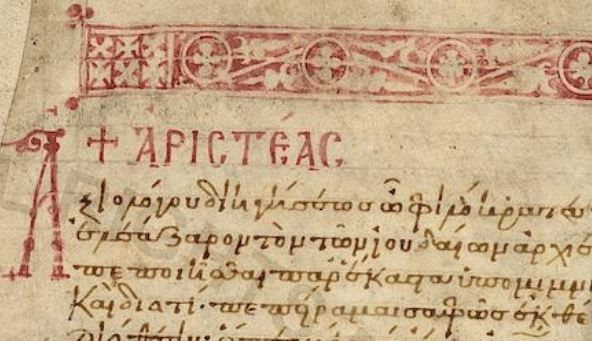
Letter of Aristeas
The Letter of Aristeas is a Hellenistic Jewish text, probably from the 2nd–3rd century BCE, that narrates the legendary origins of the Septuagint, the Greek translation of the Torah. Imagine Judaism hiring a Hellenistic spin doctor: that’s Aristeas (a literary pseudonym, ostensibly a courtier in Ptolemy’s court, but more likely an Alexandrian Jew who wanted to make Judaism acceptable in Greek social and political circles). He stages the Septuagint’s birth as a miracle of translation, seventy-two scholars producing identical texts. Beneath the miracle, the letter is a sales pitch – Judaism as rational, ethical, and library-worthy. It’s less about history than about branding: Torah as timeless wisdom, fit for the shelves of Alexandria and the minds of philosophers. The letter was consigned to the Jewish apocrypha because it was judged pseudepigraphal (falsely attributed to an important figure), legendary rather than historical, and primarily apologetic in nature, not to transmit divine revelation.
The letter consists of 322 paragraphs, so I’m not going to do them one at a time, but will give a shot at breaking this up into sensible concepts that are expressed.
- Paragraphs 1-8. Aristeas kicks off with a classic PR move: “Philocrates, trust me, I was there.” Philocrates is less brother than rhetorical sock puppet, a Greek-sounding confidant invented to make the tale feel cozy. The author flexes his supposed insider status at Ptolemy’s court, positioning himself as the guy with the backstage pass to the king’s grand project of stocking Alexandria’s library with the world’s wisdom, including the Jewish Law. The intro is pure stagecraft: credibility asserted, audience imagined, Judaism’s laws dressed up for their debut on the Greece’s cultural catwalk.
- Paragraphs 9-11. Demetrius is the king’s librarian, caught between shelves and politics. He knows the library is a Babel of alphabets, but Hebrew feels especially opaque. His worry isn’t xenophobia, it’s quality control: how to know which scrolls are worth cataloguing if he can’t read them? The king’s letter to the high priest is the workaround: outsource discernment to the guardians of the tradition. Moses’ Torah enters Alexandria not by Demetrius’ linguistic scholarship, but by priestly authority. The librarian’s role is less curator than facilitator, ensuring the gold standard of Jewish texts is transmitted intact, even if the alphabet looks strange to Greek eyes. Today, we can be amused by the thought of the Greek alphabet being the alphabetic standard.
- Paragraphs 12-20. Aristeas shifts from librarian to lobbyist, petitioning for Jewish slaves like a courtier with a conscience. He plays the bureaucracy like a prelude, then hits the king with the big ask: not just freedom, but back pay. Miraculously, Ptolemy agrees; emancipation plus remuneration, a royal two-for-one. Mystical spin? The Torah isn’t just fit for the library; its people are fit for liberty. Worth noting… the Exodus said “we’re outta here,” but Aristeas rewrites the script: apparently, enough Jews wandered back or stuck around to get re-enslaved, first by Egyptians, then inherited by Greeks. Plot hole? Absolutely. But it’s a convenient one, because it lets Ptolemy cosplay Moses, freeing slaves and cutting checks.
- Paragraphs 21-27. Ptolemy issues his decree: Jewish slaves are freed, their bondage declared unjust. Cue the royal benevolence soundtrack. But when the treasury opens, the coins jingle not for the liberated, but for their ex‑masters; compensation for “losses.” It’s emancipation with a side of economic appeasement: freedom for the captives, hush money for the owners, and PR glory for the king. Liberation, yes, but reparations flow uphill.
- Paragraphs 28-40. Demetrius, the librarian with standards, memos Ptolemy: “Your Jewish texts section is a mess, with shoddy translations everywhere.” Ptolemy, keen to polish his image as enlightened monarch, fires off a decree to High Priest Eliazar of Jerusalem: “Send six scholars from each tribe to fix this”. To underline his magnanimity, he reminds Eliazar that he freed over 100,000 Jewish slaves, and then drops a sweetener of 100 talents of silver, nearly four tons, like a kingly flex that says, “I’m serious about this project.” The whole episode reads less like reverence for scripture than bureaucratic theater: a memo, a decree, a bribe, and a PR flourish, all to ensure the library shelves don’t look shabby.
- Paragraphs 41-50. Eliazar’s reply is pure choreography of deference: he praises Ptolemy’s letter, swoons over the gifts, and signs off on every condition without hesitation. The elders are dutifully listed, proof that Jerusalem’s machinery is humming along in grateful compliance. Aristeas, meanwhile, slips in a flattering cameo, hailed as learned and important, which is convenient self-promotion for a fictional narrator. The whole passage is a feedback loop of patronage and praise: the king flexes generosity, the priest bows in ritual obsequiousness, and the author canonizes himself as indispensable. Translation here is less sacred labor than self-promotion, with holiness measured in four tons of silver bullion and self-regard.
- Paragraphs 51-72. Eliazar’s enthusiasm sends Ptolemy into full benefactor mode: after showering Jerusalem with silver, he decides to add an altar table. He resists the imperial urge to supersize it, guessing, without Torah training, that dimensions matter. So he keeps the sacred measurements intact, then drowns the thing in gold and gems. The gesture is half ritual respect, half political theater: a king posing as deferential student while staging imperial satire, turning an already elaborate furnishing into a glittering billboard of his largesse.
- Paragraphs 73-82. This stretch reads less like ritual devotion and more like an audit gone wrong. After the altar table, Ptolemy keeps adding golden and bejeweled bowls, vials, and an enigmatic “maeander” (a word usually referring to the design element of a Greek key, but here, referring to some sort of furnishing) until the list feels like a warehouse manifest. The satire sharpens here: Aristeas notes that the king’s fixation on dazzling gifts came at the expense of governance, draining resources for spectacle rather than sustaining the state. The passage paints a picture of a ruler who treats the state treasury as his personal grab bag, using it to project an image of over-the-top generosity, just to impress a distant dignitary.
- Paragraphs 83-95. Here Aristeas shifts from theological awe to managerial admiration: the Temple is presented less as a mystical locus than as a well‑oiled sacrificial machine. He marvels at the priests’ discipline, their ability to process offerings with efficiency, and even the infrastructure, the drainage system whisking blood and offal away from the city like a sanitary conveyor belt. It’s a portrait of ritual labor as industrial precision, priests as workers on a sacred assembly line. But then comes the puffery: Aristeas claims thousands of animals are sacrificed daily, a number that strains credulity. The exaggeration is deliberate, a rhetorical inflation meant to underscore the priests’ dedication and the Temple’s grandeur. In reality, the logistics alone would make such throughput implausible, but the hyperbole serves the author’s agenda: to frame Jerusalem’s cult not just as holy, but as impressively efficient, a spectacle of labor sanctified by scale.
- Paragraphs 96-113. The letter paints High Priest Eliazar as practically extraterrestrial, with his radiant robes and glowing presence; a figure who seems more beamed down than born. Then, in a twist, the Temple is described as encased in a citadel bristling with oath-sworn guards, a fortress‑temple that most other sources never mention, equal parts sanctuary and military installation. Jerusalem itself gets only a flattering cameo, likened to Alexandria to butter up Ptolemy, while the rural population is kept on a tight leash, allowed into the city only sparingly so they stay tethered to agriculture.
- Paragraphs 114-120. This section reads like Aristeas suddenly swapped his quill for a clipboard: demographics, spice trade, defense logistics… tick, tick, tick. It’s Jerusalem stripped of poetry, presented as the CIA World Factbook 3rd century Greek edition. The perfunctory tone makes it clear he’s just clearing his bureaucratic throat before the real show, the selection and translation drama. In short, this section is less “city of God” and more “city of spreadsheets,” a dutiful data dump that feels like he’s rushing to get past the boring bits so he can finally talk about what he actually cares about.
- Paragraphs 121-132. Aristeas, or the author, finally drops the travelogue and starts curating a philosophical exhibit. First, he sizes up the seventy‑two scholars chosen by Eliazar – men of impeccable character, disciplined intellect, and moral restraint, the dream team of translation ethics. Then Eliazar takes the stage, delivering what amounts to Judaism’s elevator pitch to the Hellenistic world: a religion defined not by ritual excess or divine multiplicity, but by rational devotion to a single, unseen God. Aristeas frames this monotheism as Judaism’s intellectual crown jewel; the faith that dared to strip the cosmos of its crowded pantheon and replace it with unity, law, and reason.
- Paragraphs 133-143. This section reads like Eliazar’s TED Talk on divine exclusivity. He’s done arguing against idols and now goes full minimalist: why clutter the cosmos with figurines when you can worship the source directly? His point – idols aren’t merely forbidden, they’re redundant. Then he goes anthropological, citing Egyptian scholars who’ve dubbed the Jews “the people of [one] God”, a sly bit of cultural judo. By invoking Egypt, the epicenter of polytheism, he’s claiming external validation: even the idol‑makers admit the Jews got the theology right. It’s a moment of intellectual swagger, positioning Judaism not as isolationist but as the lone rational system in a world of divine clutter.
- Paragraphs 144-171. Paralleling today’s Talmud reading, Eliazar is in full guru‑mode. He insists that kashrut isn’t about divine appetite or mystical closeness, it’s about communal hygiene, keeping Jews distinct from the cultural riffraff. The dietary rules become a social firewall: don’t eat their food, don’t mimic their manners, don’t blur the boundary lines. And to drive the point home, he parades mice and weasels as caricatured human archetypes: mice as timid nibblers, weasels as sly opportunists; and warning that to consume (or in human terms, associate with) them is to risk becoming them. The satire is sharp: the Torah’s food laws reframed as a cosmic HR manual, complete with animal mascots, designed to keep the tribe disciplined and separate.
- Paragraphs 172-186. Diplomacy staged as theater: Eliazar dispatches envoys loaded down with gifts, a ceremonial gesture that frames the translation project as tribute. Ptolemy, eager to play magnanimous king, breaks his own regal waiting rules and meets them immediately, dumpling all protocol in action. The bows and gift‑exchange are scripted reverence, capped by his appointment of Dorotheus as kosher concierge. Dorotheus’s feast is less about food than optics: proof that the palace respects Jewish law, a banquet doubling as press release. The whole scene is political choreography. Eliazar sends gifts to flatter, Ptolemy stages hospitality to impress, and the translation project is wrapped in spectacle of mutual honor.
- Paragraphs 187-202. Ptolemy turns the feast into a royal Q&A, tossing each envoy a question about ruling wisely and living richly. One by one, they answer with polished Torah‑infused aphorisms about justice, restraint, wisdom; all framed as obedience to God’s law. The king beams, thanks them, and cheerfully calls for more food. Yet beneath the convivial surface lurks the monarch’s prerogative: this isn’t just admiration, it’s a test. By probing their theology under the guise of banter, Ptolemy gauges whether Jewish wisdom is a harmless manual for virtue or a rival authority that could threaten his throne. The feast resumes, but the undertone is clear, and every toast doubles as surveillance.
- Paragraphs 203-220. The second‑night feast in Aristeas is really a double performance: on the stage, Ptolemy lines up the “second rank” sages, repeats the same questions, and gets the same ritual chorus of follow God’s law, walk the divine path. It looks like political theater, the king playing philosopher‑patron while the sages dutifully affirm divine authority. But behind the curtain, the narrator is the one pulling strings. By scripting repetition across ranks, the author isn’t showing us Ptolemy’s curiosity so much as hammering home a literary propaganda point: Jewish wisdom is inexhaustible, orderly, and uniform, no matter how many sages you summon. The feast becomes a fictional staging where royal inquiry is just a prop, and the real agenda is to elevate Jewish tradition within a Hellenistic frame: abundance of wisdom, hierarchy of ranks, and consistency of answers all reinforcing the narrator’s claim that fidelity to God’s law is the only true response.
- Paragraphs 221-294. I’m covering a long swathe, because, what’s covered is a week‑long dinner theater, a royal marathon of staged enlightenment. Each night Ptolemy questions another ten sages, moving down the ranks, cueing them to deliver polished, pious monologues that loop inevitably back to the divine path, like contestants on “Philosophy Idol” who know the judges only award points for theological harmony. The repetition becomes its own spectacle: Ptolemy’s court as a well‑oiled propaganda kitchen, serving identical platters of virtue under different garnishes. By the end, the king isn’t basking in newfound wisdom so much as smugly applauding his own stagecraft; delighted not by the content of the answers but by the sages’ flawless devotion to the party line.
- Paragraphs 295-311. The narrative finally circles back to Philocrates, Aristeas’ fictional confidant, with a flourish of bureaucratic reassurance: every word has been faithfully recorded by Ptolemy’s stenographers, so you can trust the tale. That rhetorical move sets the stage for the real point, the translation itself, framed as a ritualized labor cycle. Under Demetrius’ supervision the translators grind through nine‑hour shifts, punctuated by kosher banquets courtesy of Dorotheus, and then review and edit their work in communal sessions. The process is staged like liturgy: scholarship as sacred service, food as ritual fuel, and textual fidelity as a collective act. The finale is a public reading before the king, turning the Torah into a court performance. It’s apologetics wrapped in theater: stenographers as divine notaries, translators as priests, and Ptolemy as patron, all conspiring to sanctify the Hebrew Bible as both politically endorsed and ritually pure.
- Paragraphs 312-322. The Letter of Aristeas wraps like the finale of a long‑running daytime soap: Ptolemy, glowing with post‑production pride, marvels that no one thought to translate the Torah before. His historians mumble excuses, he waves them off, and the translators get their curtain call. Cue the gift montage: gold, fine clothes, furniture, and a care package for Eliazar, all set to triumphant music. The king delivers his closing line of “Come back anytime, the door is always open,” with the warmth of a star who knows the ratings are good. And then Aristeas, ever the straight man, signs off to Philocrates insisting that every word is absolutely, totally, no doubt about it factual and unembellished, which lands like the wink to camera before the credits roll.